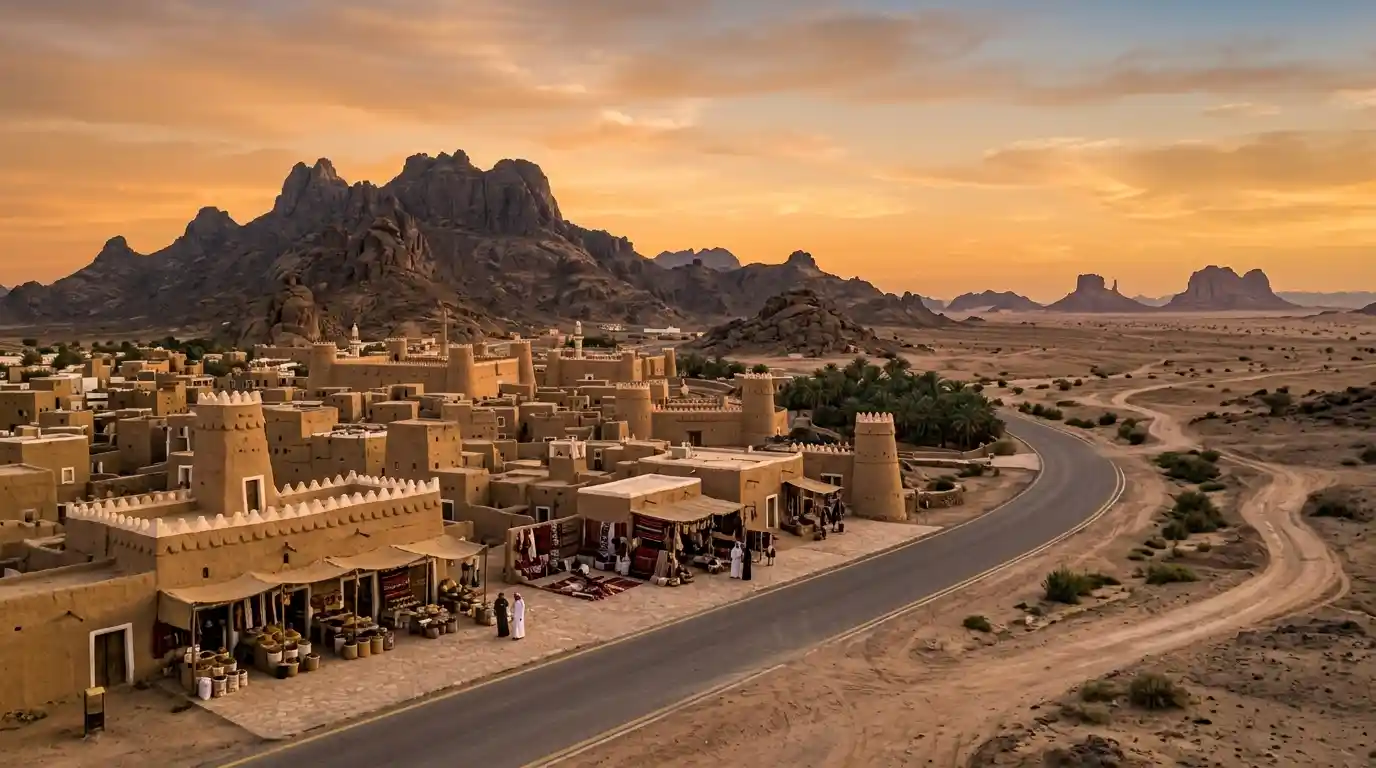
Hail Itinerary: How to Plan Your Visit
A practical Hail itinerary should separate the destination into three distinct layers: Hail city heritage, the UNESCO-listed rock-art landscape around Jubbah, and optional mountain or desert excursions. Trying to mix all three continuously creates unnecessary driving and reduces the time available to understand the places themselves. A better route begins with the city’s forts, museum, markets and viewpoints, gives Jubbah a dedicated regional block, and then adds nature, Hatim Al Tai heritage, camping or more distant archaeological sites only when they match your interests.
This structure aligns closely with current official tourism planning. Visit Saudi recommends using a car to explore Hail’s cultural sites and mountain landscapes and highlights A’arif Fort, Al Qishlah Palace, Barzan, local markets, Al Samra, Jubbah and surrounding natural areas as complementary parts of the destination. Current organized Hail experiences similarly group the principal city heritage before moving into Jubbah and more remote regional landscapes.
The most important planning decision is not how many attractions can fit into one day. It is deciding which experiences belong geographically and thematically together. This Hail itinerary therefore owns the non-duration route-planning intent rather than duplicating fixed schedules. Travelers with a specific short stay can use one day in Hail, 2 days in Hail, or 3 days in Hail once the available time is fixed.
For the broad destination overview, start with the Hail travel guide. If you are still choosing attractions, compare them first through things to do in Hail.
Hail Itinerary at a Glance
| Route block | Best experiences to combine | Main planning logic |
|---|---|---|
| City orientation | Hail Regional Museum, central heritage | Build context before outdoor monuments |
| Forts and historic core | A’arif Fort, Al Qishlah Palace, Barzan area | Keep central heritage geographically grouped |
| Market and food | Traditional market, lunch, cafés | Natural break within the city route |
| Scenic finish | Al Samra Mountain | Strong later-day viewpoint |
| Jubbah excursion | Jabal Umm Sinman rock art, visitor interpretation | Give UNESCO archaeology its own road block |
| Nature extension | Aja or Salma mountains, reserve or desert scenery | Add only when landscape travel is a priority |
| Cultural extension | Hatim Al Tai associations, Tuwaren area | Best for travelers interested in regional cultural memory |
| Advanced archaeology | Shuwaymis | Separate, much longer regional excursion |
The order can shift around weather, attraction access and your arrival time, but the geographic principle should remain intact: urban heritage together, Jubbah separately, and distant desert sites only when the itinerary has enough space for them.
Start With Context Before Collecting Landmarks
A Hail itinerary becomes more meaningful when you understand why the region matters before seeing a succession of forts and rock carvings. Current Visit Saudi heritage guidance recommends beginning with Hail Regional Museum for background before moving into outdoor heritage locations.
That recommendation is useful because Hail’s story spans very different periods. Prehistoric rock art around Jubbah belongs to a completely different historical context from the fortified mudbrick architecture inside Hail city, while the traditions associated with Hatim Al Tai occupy another cultural layer again.
A museum-oriented introduction can therefore prevent the trip from becoming a sequence of attractive but disconnected photographs. Travelers particularly interested in collections can expand this part of the route through museums in Hail.
If museums are not your priority, move directly into the historic core but retain the same principle: understand the city before setting off toward remote archaeology.
Group A’arif Fort and Al Qishlah Palace Together
A’arif Fort and Al Qishlah Palace form the strongest historic pairing within the city. A’arif occupies a high ridge above Hail and is one of its most recognizable landmarks, while Al Qishlah is a large mudbrick military complex with a very different scale and architectural character. Current Visit Saudi material features both among the city’s defining heritage sites and groups them naturally within Hail sightseeing routes.
Visit A’arif with enough time to appreciate its elevated position rather than treating it only as an exterior photo stop. The view helps establish the relationship between Hail’s urban area, mountain backdrop and open northern landscape.
Al Qishlah then provides a more monumental ground-level experience. Its long walls, courtyards and towers communicate a different phase of Hail’s built heritage, making the two sites complementary rather than repetitive.
Current access and opening arrangements can change, so verify them shortly before visiting instead of assuming that every interior will be available exactly when your Hail itinerary reaches it.
Use A’arif Early When Photography Matters
Current Visit Saudi heritage guidance recommends morning light for A’arif Fort, which makes an early heritage block particularly attractive for photographers.
Morning also provides practical advantages during warmer conditions. Walking around exposed fortifications is easier before the strongest daytime heat, and the city generally becomes simpler to navigate when you begin with a clear destination rather than drifting between unrelated stops.
If photography is central to your trip, the dedicated Hail photography spots guide can help refine light and location decisions without allowing photography detail to dominate this broader route.
Add Barzan and the Traditional Market as the Next City Layer
After the two principal forts, shift into Hail’s historic-commercial character. Current Visit Saudi guidance recommends connecting the Barzan heritage area with the nearby market rather than treating the surviving historical remains as an isolated attraction.
This change of pace is useful. Forts tell part of the city’s institutional and defensive story, while a traditional market introduces trade, crafts, spices, food and contemporary daily movement.
A Hail itinerary should deliberately alternate between monumental heritage and lived city spaces. Spending every hour inside archaeological or architectural sites can make even an outstanding heritage destination feel repetitive.
Travelers who enjoy this urban layer can continue with shopping in Hail or build a more deliberate walking sequence through the heritage walk in Hail.
Put Lunch Near the Historic Core
Avoid driving across Hail solely because a restaurant has a slightly higher rating. The city route is stronger when lunch sits naturally between the heritage core and whatever comes next.
Hail’s hospitality and regional food culture are recurring themes in current official tourism material, and organized itineraries commonly include traditional meals alongside the heritage experience.
Use the meal as a genuine pause rather than another task. Northern Saudi hospitality, coffee, local dishes and conversation can add as much cultural context as another monument.
For more focused planning, use food in Hail and best restaurants in Hail. Coffee-focused travelers can reserve a later stop through best cafes in Hail.
Finish the City Route at Al Samra Mountain
Al Samra Mountain works particularly well near the end of a city sightseeing block because it shifts the perspective from individual monuments to the whole urban landscape. Current Visit Saudi guidance highlights the mountain for panoramic views and describes it as especially scenic around sunset and evening.
This sequencing also avoids wasting the best later light inside a long indoor attraction. After forts, markets and food, the mountain gives the Hail itinerary a natural visual conclusion.
Do not arrive at the exact sunset minute if photography matters. Allow enough time to find your viewpoint, see the city before the light changes and remain long enough to watch the transition toward evening.
Travelers who want to continue after dark can use things to do in Hail at night.
Keep Jubbah Separate From the City Core
Jubbah should not be inserted casually between A’arif Fort and dinner. UNESCO places Jabal Umm Sinman at Jubbah approximately 90 kilometers northwest of Hail, making it a meaningful regional excursion rather than another urban attraction.
The road distance is only one reason to separate it. The archaeological experience itself deserves attention. Jabal Umm Sinman forms one component of the UNESCO-listed Rock Art in the Hail Region and contains extensive petroglyphs and inscriptions within a landscape that once overlooked a freshwater lake. UNESCO describes the wider property as preserving an exceptionally rich record of human activity across thousands of years.
Give Jubbah enough time for interpretation, observation and photography rather than measuring the stop by how quickly you can see one famous panel.
Why Jubbah Deserves Its Own Route Block
The importance of Jubbah lies in the combination of art and landscape. UNESCO explains that the Jabal Umm Sinman carvings developed around an environment that once supported a freshwater lake, with people and animals leaving evidence of their presence as environmental conditions changed over long periods.
This transforms the experience from “old carvings on rocks” into a record of adaptation. Human figures, animals, inscriptions and changing artistic styles preserve clues about communities responding to a landscape becoming increasingly arid.
Current Visit Saudi heritage guidance advises comfortable shoes and suggests using a guide when deeper interpretation of Jubbah’s inscriptions matters.
That is particularly useful for first-time archaeology travelers. Without context, the eye can pass quickly over carvings whose significance is much greater than their physical size suggests.
Do Not Touch or Enhance the Rock Art
Rock art should be observed without physical intervention. Do not touch carvings unnecessarily, trace them with fingers, apply water, chalk or any other substance to increase contrast, or climb onto decorated surfaces for photographs.
UNESCO identifies preservation pressures around the World Heritage property and emphasizes protection of the petroglyphs, inscriptions and environmental setting.
A respectful Hail itinerary should leave the archaeological surface exactly as it was encountered.
Photography can capture details without altering the rock.
Decide Whether You Need a Guide at Jubbah
Independent travel provides flexibility, especially for experienced heritage travelers comfortable researching archaeological contexts. A knowledgeable guide, however, can help identify imagery, distinguish periods, explain the former lake environment and connect individual carvings to the broader UNESCO significance.
Current Visit Saudi specifically recommends a guide for travelers seeking deeper insight into Jubbah’s inscriptions.
A guide also reduces the temptation to spend too much time searching for specific panels based only on online photographs.
If you choose independent travel, read enough beforehand to understand what you are looking at and follow current local access rules.
Shuwaymis Is Not an Easy Jubbah Add-On
The second component of the UNESCO property lies around Jabal Al-Manjor and Jabal Raat near Shuwaymis. UNESCO places it approximately 250 kilometers south of Hail, far beyond the distance to Jubbah.
This matters enormously for route planning. Jubbah can fit naturally into many Hail trips, while Shuwaymis requires a much greater road commitment.
Travelers deeply interested in archaeology may find the additional journey worthwhile because UNESCO describes both components together as among the richest rock-art complexes in Saudi Arabia and the wider region.
For ordinary first-time visitors, however, prioritize Jubbah and use day trips from Hail to decide whether Shuwaymis deserves a separate excursion.
Add Mountains Only When Nature Is a Real Priority
Hail’s mountain scenery is a defining part of the destination, but nature should not be added simply to make the itinerary longer. Current Visit Saudi material highlights the mountains around Hail for hiking, photography and sunset landscapes, alongside the city’s heritage and archaeological attractions.
If hiking or landscape photography is important, dedicate meaningful time to the mountains rather than inserting a roadside photograph between Jubbah and dinner.
Travelers who want a more adventure-oriented trip can use desert safari in Hail or camping in Hail to develop that side of the route.
Do not drive onto unfamiliar desert tracks because a location appears close on a satellite map. Road surfaces, sand and remote conditions can transform a short-looking detour into a much more difficult drive.
Hatim Al Tai Heritage Adds Cultural Depth
Hail’s cultural identity is closely associated with Hatim Al Tai, remembered across Arab tradition for generosity. Current official tourism material continues to feature places and experiences connected with his story as part of regional heritage exploration.
This part of the Hail itinerary will appeal more strongly to travelers interested in Arabic literature, oral tradition and cultural history than to visitors focused only on architecture or archaeology.
Do not treat every site associated with a legendary or historical figure as if it carries the same documentary certainty as a UNESCO archaeological inscription. Its value may lie as much in cultural memory and storytelling as in physical remains.
That distinction makes the experience richer rather than weaker.
Use Tuwaren or Other Cultural Extensions Selectively
Current Visit Saudi experience listings pair city heritage and Jubbah with locations associated with Hatim Al Tai and the Tuwaren area, demonstrating one way a wider cultural route can be structured.
This is an optional layer, not a first-visit obligation.
If you have limited time, A’arif, Al Qishlah, the central market, Al Samra and Jubbah communicate Hail’s identity more efficiently. Add Tuwaren when you specifically want deeper regional cultural context.
Travelers searching for lesser-known additions can consult hidden gems in Hail only after the core route is secure.
Use Faid as a Separate Historical Excursion
Faid is another significant heritage location in Hail Province and appears in current Visit Saudi destination recommendations.
Its history relates to major movement and settlement routes across the Arabian Peninsula, making it potentially valuable for travelers whose interests extend beyond forts and rock art.
However, it should not compete with Jubbah for the same limited road block on a rushed first trip. Decide what kind of history matters more to you and give that excursion enough time.
Adjust the Hail Itinerary for Cooler Weather
Visit Saudi currently recommends the cooler period between November and March for exploring Hail, especially when outdoor adventures, mountains and heritage sites are priorities. It also recommends a rental car for moving between the region’s cultural and natural attractions.
Cool weather allows the Hail itinerary to remain flexible. You can walk around A’arif, explore Jubbah, visit the market and remain at Al Samra through sunset without making heat avoidance the central concern.
Even during the cooler season, carry layers. Hail’s northern inland setting can produce substantial differences between sunny daytime conditions and evenings.
The detailed when-to-go decision belongs on best time to visit Hail, while Hail weather by month provides the climate-reference layer.
Adjust the Route for Hot Weather
A hot-weather Hail itinerary needs a different order.
Start outdoor heritage earlier. Use museums, lunch, cafés, shopping or accommodation rest through the strongest heat. Move Al Samra and other viewpoints toward later hours.
Jubbah requires particular care because the archaeological landscape is exposed and cannot be experienced entirely from an air-conditioned vehicle. Comfortable shoes, sun protection and sufficient water become essential. Visit Saudi’s heritage guidance specifically recommends water, sun protection and suitable footwear for Hail’s outdoor sites.
Travelers needing more climate-controlled options can use indoor things to do in Hail.
Renting a Car Usually Creates the Best Route
Current Visit Saudi guidance explicitly recommends renting a car to explore Hail’s cultural sites and mountain landscapes at your own pace.
That recommendation is particularly important for this itinerary because Jubbah lies well outside the city. A rental car lets you control departure time, stop for food or fuel, adjust photography stops and return without depending on finding transport in a smaller regional settlement.
Within central Hail, taxis or ride-hailing can still be practical, especially if you do not want to park repeatedly.
Use getting around Hail for the full transport comparison and driving in Hail if you plan to self-drive.
Do Not Confuse Road Trips With Off-Road Driving
A Hail itinerary can involve significant road travel without requiring unstructured off-road driving. Jubbah and major heritage attractions should be approached through appropriate established routes.
Mountain, reserve, camping or desert-safari activities can introduce very different terrain and vehicle requirements.
A standard rental car suitable for paved regional highways may not be appropriate for deep sand or rough desert tracks. Confirm both vehicle capability and rental conditions before leaving established roads.
Choose Accommodation for Road Efficiency
Most first-time visitors benefit from staying in Hail city because the major urban attractions, restaurants and services remain convenient while Jubbah and other excursions can be reached by road.
Current Visit Saudi guidance notes that accommodation options can include modern hotels, heritage-oriented stays and farm accommodation.
Do not choose a remote property solely because it looks atmospheric if your itinerary requires repeated crossings of Hail to reach the opposite side of the region.
Use where to stay in Hail to compare location against your actual route.
Keep Arrival Periods Light
If you arrive through Hail International Airport, avoid placing Jubbah or another substantial road excursion immediately after landing. Flight delays, baggage, rental-car collection and hotel check-in can consume the margin.
A better arrival block might include a central market, café, easy city heritage stop or Al Samra if daylight and energy allow.
The Hail itinerary should grow more ambitious only after you are settled, rested and certain about transportation.
Keep Departure Periods Even Lighter
Do not return from Shuwaymis, a desert camp or another distant regional site immediately before a flight.
Use the final period for an easy café, market purchase, museum or urban stop that keeps you within predictable driving distance of the airport.
A trip is not improved by adding one final attraction if the consequence is watching the clock throughout the visit.
Families Should Prioritize Variety Over Quantity
A family Hail itinerary should alternate between forts, viewpoints, food, parks and one major regional heritage experience rather than forcing children through multiple similar archaeological stops.
Jubbah can be excellent for older children when the rock art is explained through animals, environmental change and the lives of people who occupied the area rather than through technical archaeological terminology alone.
Current Visit Saudi highlights Hail as a mix of heritage and natural experiences, which makes this kind of varied family planning possible.
Use Hail with kids and parks in Hail when family pacing needs more attention.
Solo Travelers Should Pre-Plan Regional Transport
Hail city itself is straightforward to explore independently, but remote archaeology changes the calculation.
If you do not want to rent a car, arrange a driver or guided excursion to Jubbah rather than assuming transportation will be easy to organize after arriving there.
Current official tours show that guided city-and-Jubbah combinations are readily used as a tourism model in the region.
For broader independent-travel considerations, use solo travel in Hail.
Couples Can Emphasize Heritage and Sunset
A couple-focused Hail itinerary can work particularly well when it avoids over-scheduling. Combine one strong heritage block, an unhurried meal, Jubbah or another landscape excursion, and an evening viewpoint rather than trying to visit every fort and museum.
Al Samra provides an obvious sunset element, while the mountains and desert open additional possibilities for scenic drives and photography.
The dedicated romantic things to do in Hail can refine this approach further.
Budget Travelers Should Concentrate Transport
Hail’s major cost pressure can come from transportation rather than attraction admission. The city and regional sites are spread far enough apart that repeated private transfers can become expensive.
A rental car shared among several travelers may offer better value than individual point-to-point rides, depending on current prices and driving comfort.
Group city attractions geographically, complete Jubbah as one deliberate excursion and avoid unnecessary cross-city restaurant journeys.
Use Hail on a budget and free things to do in Hail for detailed cost planning.
Photographers Should Separate City and Archaeology Sessions
Hail’s city architecture and Jubbah’s rock art require very different visual approaches.
A’arif benefits from directional light that reveals mudbrick texture and the surrounding city. Al Qishlah offers repetition, towers, doorways and interior geometry. Al Samra provides landscape-scale city views.
At Jubbah, the challenge becomes recording carvings while preserving their context within the larger rock landscape. UNESCO’s own documentation emphasizes both the petroglyphs and their environmental setting as essential attributes of the property.
Do not rush from city architecture to Jubbah simply to maintain one photography checklist. Give each subject its own block.
Camping and Stargazing Need Their Own Logistics
Camping and stargazing can add a compelling northern-desert dimension, but neither should be improvised at the end of a normal sightseeing day.
A deliberate camp requires suitable access, shelter, food, water, temperature preparation, waste management and an appropriate vehicle. Stargazing requires clear skies, a safe location and certainty about the return route.
Use camping in Hail and stargazing in Hail for those specialized plans rather than stretching the city itinerary into an unplanned overnight excursion.
When to Choose a Desert Safari Instead
Choose a structured desert experience when the landscape itself is a major priority but you do not have the vehicle, route knowledge or interest required to organize independent desert travel.
A desert safari can also provide variety after several heritage-heavy stops.
The specialist desert safari in Hail should be used to compare actual desert activities, vehicle needs and operator considerations.
How Fixed-Duration Hail Plans Fit This Framework
This route can be compressed or expanded without changing its logic.
A very short visit prioritizes the city heritage core and forces a decision about whether Jubbah is important enough to replace other urban attractions.
With more time, Jubbah becomes easier to include without rushing, while mountains, Faid, Hatim Al Tai heritage, Shuwaymis, camping or desert experiences can be added selectively.
The point is not to fill every additional day automatically. Extra time should improve depth or geographic range.
Use the duration-specific pages rather than converting this general Hail itinerary into several overlapping schedules.
A Practical Hail Route Framework
Begin with context. Visit Hail Regional Museum when archaeological understanding matters, or move directly into A’arif Fort if you prefer to start visually. Current Visit Saudi guidance recommends the museum-before-outdoor-sites approach for travelers who want stronger historical grounding.
Keep A’arif, Al Qishlah and the Barzan area within one city heritage block. Add the traditional market and lunch before moving to a different part of Hail.
Use Al Samra as the natural scenic conclusion when the weather and daylight cooperate. The mountain is particularly well suited to a later-day or evening stop.
Reserve Jubbah for its own regional excursion. UNESCO places Jabal Umm Sinman around 90 kilometers northwest of Hail, and the carvings form part of a World Heritage landscape recording thousands of years of human activity and environmental change.
Add Shuwaymis only when archaeology is important enough to justify a much longer drive. At roughly 250 kilometers south of Hail, it should never be treated as a minor extension to Jubbah.
Use mountains, a desert experience, Tuwaren, Faid, camping or stargazing as optional layers according to your interests. A strong Hail itinerary does not need all of them.
Finally, protect arrival and departure periods from long road trips. Hail is most rewarding when the route has enough space for its major landscapes and historical sites rather than reducing them to stops between driving segments.
For wider national planning, continue with the Saudi Arabia travel guide.
Frequently Asked Questions
What should I prioritize on a first Hail itinerary?
Prioritize A’arif Fort, Al Qishlah Palace, the central heritage and market area, Al Samra Mountain and a dedicated excursion to Jubbah. These provide the strongest combination of city heritage, landscape and archaeology.
Should I visit Jubbah separately from Hail city attractions?
Yes. UNESCO places Jabal Umm Sinman at Jubbah approximately 90 kilometers northwest of Hail, so it deserves a separate regional block rather than being squeezed between central attractions.
Should I visit a museum before Jubbah?
It can help considerably. Current Visit Saudi heritage guidance recommends beginning at Hail Regional Museum for background before visiting outdoor sites.
Can I visit Jubbah and Shuwaymis together?
Technically they belong to the same UNESCO World Heritage property, but they are far apart. Jubbah is around 90 kilometers northwest of Hail, while Shuwaymis is roughly 250 kilometers south, making a casual same-route combination impractical for most travelers.
Do I need a car for a Hail itinerary?
A car is highly useful. Visit Saudi recommends renting one to explore the region’s cultural sites and mountain landscapes at your own pace.
When should I visit Al Samra Mountain?
Later in the day works particularly well. Current Visit Saudi guidance highlights Al Samra for panoramic city views and especially scenic sunset and evening conditions.
Is Hail suitable for families?
Yes. Forts, museums, markets, parks, viewpoints and Jubbah provide enough variety to avoid a heritage-only schedule. Families should reduce driving overload and adapt outdoor time to weather and children’s walking ability.
What is the best time to follow this Hail itinerary?
The cooler period is the easiest for most travelers. Visit Saudi recommends November through March for outdoor exploration in Hail.
Should I hire a guide for Jubbah?
It is not essential for every traveler, but current Visit Saudi guidance recommends a guide when you want deeper insight into the inscriptions and archaeological context.
Can I add camping to the itinerary?
Yes, but treat it as a separate planned experience. Camping requires additional vehicle, equipment, weather and overnight logistics rather than being an impulsive extension after city sightseeing.
How should photographers structure the route?
Use city heritage and architectural photography as one block, Jubbah as a separate archaeological block, and Al Samra or mountain landscapes for later light. This reduces unnecessary driving and allows each subject enough time.
Is Hail worth including in a wider Saudi road trip?
Yes for travelers interested in archaeology, traditional architecture, mountains and northern Saudi culture. Hail also works naturally as a regional stop within longer routes connecting central Saudi Arabia, Qassim and AlUla.