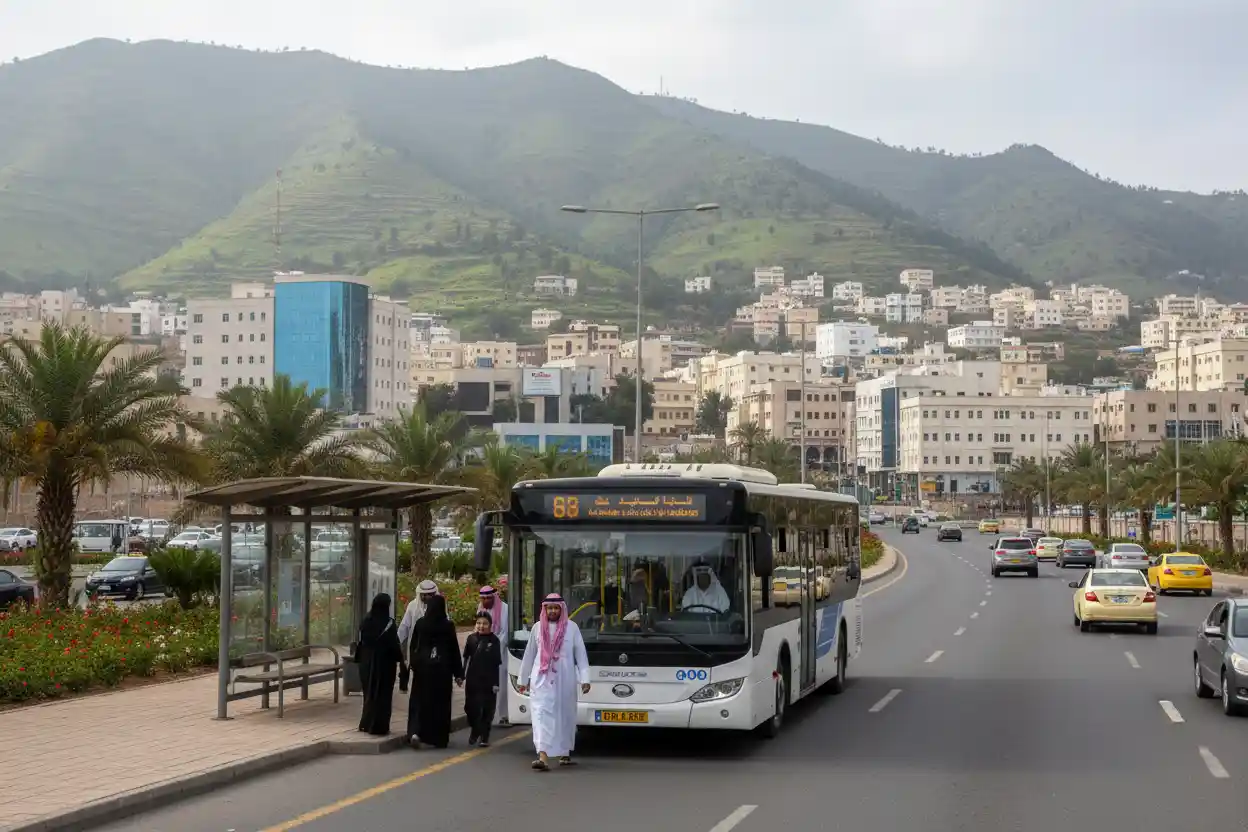
Public Transport in Abha: Routes, Cards & Practical Tips
Public transport in Abha includes an organized urban bus network serving Greater Abha, with routes extending across Abha, Khamis Mushait and Uhud Rifaida. Official project information identifies 13 routes, 55 buses and 196 stops across a network covering more than 300 kilometers, giving residents and visitors a genuine bus option for many urban journeys rather than requiring a taxi or rental car for every trip. SAPTCO’s latest corporate information also continues to identify Abha among the cities in which the company operates public transport projects.
For travelers, however, the bus network is best viewed as one part of an Abha transport strategy, not a complete replacement for every other mode. Buses can work well when your hotel and destination sit close to useful stops, particularly for journeys within the Greater Abha urban area. Mountain viewpoints, remote parks, hiking trailheads and regional attractions may still be considerably easier with a taxi, ride service, rental car, private driver or organized excursion.
SAPTCO’s wider urban-transport system also uses digital payment infrastructure, including mobile-app functions for payments, physical and virtual transport cards, card recharging and transaction information. Its urban transport guidance additionally describes ticket-vending machines that can issue or recharge smart cards where those facilities are provided.
Because routes, stop patterns, payment arrangements and operating details can change, travelers should check SAPTCO’s current digital information before setting out rather than depending on an old screenshot or static route list. This page focuses specifically on using buses and related public transport. For all transport choices considered together, use the broader Abha travel guide rather than expecting buses to serve every travel situation.
Public Transport in Abha at a Glance
| Question | Practical answer |
|---|---|
| Does Abha have public buses? | Yes |
| What area does the network cover? | Greater Abha, including Abha, Khamis Mushait and Uhud Rifaida |
| How large is the network? | 13 routes, 55 buses and 196 stops in published project information |
| Is it useful for tourists? | Yes, especially for suitable urban journeys |
| Can buses replace a rental car completely? | Usually not for mountain and regional sightseeing |
| Are transport cards supported? | SAPTCO urban transport supports physical and virtual card systems |
| Can cards be recharged digitally? | SAPTCO states its mobile app provides card-charging functions |
| Are ticket machines available? | SAPTCO’s urban system supports TVMs where deployed |
| Should you rely on an old route map? | No; check current route and stop information |
| Is Abha International Airport definitely on every tourist-useful route? | Do not assume so without checking the current network |
| Are buses ideal for Al Soudah or Rijal Almaa? | Generally not as the default planning assumption |
| Are buses useful on a budget? | Yes, when routes align with the journey |
The most important point is that the network exists at a meaningful metropolitan scale. Public transport in Abha is therefore worth checking before automatically booking taxis for every movement around the city.
How the Abha Bus Network Is Organized
The public bus project was designed for Greater Abha, rather than only the administrative center of Abha itself. Official Saudi Press Agency reporting describes a network linking Abha, Khamis Mushait and Uhud Rifaida through 13 routes, 55 buses and 196 stops. The project was developed with coordination between regional authorities and the transport regulator to fit the road network and wider urban plans.
SAPTCO’s corporate reporting gives a network distance of approximately 337 kilometers for the Abha project and confirms the same route, bus and stop counts.
For visitors, this wider coverage matters because Greater Abha functions as a connected metropolitan area. A hotel, restaurant, commercial district or local attraction may technically sit outside central Abha while remaining part of the broader urban travel pattern.
The network should therefore be understood as a metropolitan system rather than a small tourist shuttle circulating only between famous attractions.
Does Public Transport in Abha Actually Operate Now?
Yes. SAPTCO’s recent corporate disclosures continue to list Abha among the cities where the company has expanded its public passenger-transport operations. The company also holds the operating contract for the public bus network across Abha, Khamis Mushait and Uhud Rifaida.
This is important because older travel advice sometimes describes public transport around Abha as very limited or treats taxis as effectively the only urban option. That picture no longer reflects the existence of the Greater Abha bus project.
Visitors should still distinguish between having a functioning city network and having a bus that conveniently serves every tourist destination. The first is established; the second depends on your particular origin, destination and current route pattern.
Check the latest network information for the journey you actually want to make.
Understanding the 13-Route Network
Published official project information identifies 13 routes across Greater Abha.
For a traveler, the number itself is less important than how those routes intersect with the places you intend to visit. Do not build your sightseeing day around the assumption that every route passes through the historic center or serves major attractions directly.
Instead, begin with your origin and destination.
Check where the nearest practical boarding stop is located, whether a direct route serves the destination, whether a transfer is required, and how far you will need to walk at the other end. In a mountainous city, the final walk can matter almost as much as the bus journey itself.
A bus stop that appears only several hundred meters away may still involve a noticeable gradient. Travelers with luggage, young children or limited mobility should pay particular attention to that last segment.
Why a Static Route List Can Be Misleading
Public transport networks evolve. Stops can move, construction can affect corridors, service patterns may be adjusted and digital journey information may be updated faster than third-party travel articles.
For that reason, this guide does not reproduce an unverified route-by-route timetable as though it were permanent.
SAPTCO describes its public transport operations as organized services running over established routes and schedules, and the company provides digital transport solutions as part of its urban service model.
Use current operator information immediately before traveling. A saved route map is useful as a rough orientation tool, but current digital information should determine the actual journey.
This matters especially when you have a timed activity, restaurant booking or onward transport connection.
Using the SAPTCO App
SAPTCO states that its urban-transport mobile application provides payment functions, card charging and access to transaction details for physical and virtual transport cards.
For a visitor intending to use buses repeatedly, checking the current SAPTCO digital system before the first journey can simplify the rest of the stay. Set up whatever payment method is currently supported, identify how cards or virtual credentials work, and review journey information before walking to a stop.
Do this from your hotel or another comfortable location rather than attempting to understand the entire payment system while a bus is approaching.
The exact app interface can change, so this article deliberately avoids describing buttons or screens that may become outdated. Look for current journey-planning, payment and card-management functions within SAPTCO’s official digital channels.
Physical and Virtual Transport Cards
SAPTCO’s general urban-transport system supports both physical and virtual transport cards. Its current service description states that the mobile app provides card-charging capability and access to card transaction information.
For travelers using buses on several days, a reusable card or virtual equivalent can be more practical than solving payment from the beginning on every journey.
Before obtaining one, check the current conditions that apply to the Aseer bus network. Confirm how the card is issued, what balance is required, whether the same credential can be managed entirely in the app and what you should do with unused balance.
Avoid loading a large amount purely for convenience if you expect to make only a handful of journeys.
Ticket-Vending Machines
SAPTCO states that its urban public-transport infrastructure can include self-service ticket-vending machines for issuing and recharging smart cards.
Travelers should interpret that as a system capability rather than assuming a machine will be positioned at every Abha bus stop. Confirm current local availability through official operator information.
Where a machine is available, it may provide an alternative to relying entirely on a smartphone. That can be helpful for travelers whose phone battery is low or who prefer a physical transport card.
Do not wait until a time-sensitive journey to learn how the payment process works.
How Much Does the Bus Cost?
Do not rely on an old Abha bus fare quoted by an unofficial travel page. Fares and payment arrangements are operational information and can change.
SAPTCO describes urban services as operating with fares that may be fixed or variable depending on the route and service type, while its digital infrastructure supports electronic payment and transport cards.
Check the current Abha/Aseer fare through SAPTCO’s official channels when planning your trip.
This is preferable to publishing a price that may be correct today but wrong when a traveler actually boards.
Budget travelers should also compare the full journey rather than the fare alone. A very inexpensive bus is excellent value when it takes you conveniently near the destination; it may be less useful if it requires long walks, multiple transfers and then a taxi for the final segment.
How Long Do the Buses Operate?
The original Greater Abha project specification was designed around an 18-hour daily operating period.
Travelers should not translate that project specification into an assumption that every route operates with identical frequency from the beginning to the end of the service day. Individual route schedules and current operating arrangements should be checked separately.
If you plan to remain out late, verify the return journey before leaving your accommodation.
A bus can be ideal for reaching an attraction during daytime but less convenient if your evening ends after the useful service window for that particular route.
Are Abha Buses Frequent?
Frequency should be checked route by route rather than treated as one network-wide number.
Even when a city bus system operates for many hours, different lines can have different intervals, and traffic may affect actual arrival times. For travelers, this means a bus journey should include some schedule margin.
Do not plan a tight sequence in which missing one bus causes you to miss a booked tour or airport departure.
Buses work best when the itinerary remains reasonably flexible. A museum, shopping area or general sightseeing district is usually easier to reach by public transport than a time-critical aviation connection with no margin for delays.
Where Can Tourists Use Buses Most Effectively?
Public transport in Abha makes the most sense for urban-to-urban journeys where stops align well with the itinerary.
Typical useful situations include traveling between accommodation and a central commercial area, moving toward Khamis Mushait when the route is convenient, reaching shopping or everyday urban districts, or reducing dependence on taxis during a longer stay.
Buses can also make sense when you plan to spend several hours in one area after arriving. Take the bus to the district, explore on foot and then return later rather than booking several short vehicle journeys within the same area.
The broader Abha itinerary can help you group sightseeing geographically before deciding which legs are suitable for public transport.
Using Buses for Sightseeing
The best approach is to plan the attraction first and the transport second.
Select what you actually want to see from things to do in Abha, then check whether the current bus network provides a sensible connection. This prevents a common budget-travel mistake: choosing activities only because they happen to sit along the easiest transport route.
A useful bus trip should save money without consuming so much extra time that the attraction becomes rushed.
When the final stop is relatively close, walking can complete the journey. When the attraction lies farther from the bus corridor, combining bus and taxi transport may still cost less than using taxis for the entire day.
Public Transport Between Abha and Khamis Mushait
The Greater Abha public bus project explicitly covers both Abha and Khamis Mushait, along with Uhud Rifaida.
This makes the network potentially useful for travelers whose accommodation, shopping, dining or other urban activities span the metropolitan area rather than remaining strictly within Abha.
However, do not assume that every Abha stop offers a direct connection to every part of Khamis Mushait. Consult the current route network and determine whether your journey requires a transfer.
The Greater Abha design is an important distinction from intercity transport. A local metropolitan journey and a long-distance coach trip are different services with different booking and operational systems.
Public Transport and Uhud Rifaida
Uhud Rifaida is also explicitly included in the Greater Abha public transport operating area. SAPTCO’s contract covers bus provision and associated systems across Abha, Khamis Mushait and Uhud Rifaida.
Travelers whose plans extend there therefore have a public-transport possibility that is worth checking before automatically arranging a private vehicle.
Again, suitability depends on the exact destination. Metropolitan coverage does not mean every point of interest sits beside a stop.
Route planning is essential.
Can You Take Public Transport to Abha Airport?
Do not assume that the Greater Abha bus network offers the exact airport connection you need without checking current route information.
Airport transport is a time-sensitive journey, and official tourism guidance continues to identify taxis, ride-hailing and rental cars as standard ground-transport options for travelers arriving at Abha International Airport.
If a current bus route serves the airport conveniently during your travel period, it may offer an economical alternative. Verify the stop, schedule and expected journey margin directly before relying on it.
For a departure flight, build significantly more buffer than you would for an ordinary sightseeing journey. Missing an attraction reservation is inconvenient; missing a flight is considerably more expensive.
Can You Use Buses to Reach Al Soudah?
Do not plan an Al Soudah excursion on the assumption that ordinary urban public transport will provide the most practical access.
The Greater Abha bus network is designed around metropolitan movement across Abha, Khamis Mushait and Uhud Rifaida. High mountain destinations create different transport demands.
A rental car, private driver, taxi arrangement or organized excursion will often provide greater flexibility for mountain travel, particularly when weather changes or you want to make several scenic stops.
Public transport in Abha is therefore strongest as an urban mobility system, not a guarantee of direct access to every natural attraction in Aseer.
Can You Take a City Bus to Rijal Almaa?
Rijal Almaa should be treated as a regional excursion rather than an ordinary Greater Abha bus journey.
Do not confuse public city buses with intercity or excursion transport. Reaching a heritage village outside the metropolitan network may require a rental car, private driver, tour or another dedicated transport service.
The distinction keeps this page within its proper scope: public transport in Abha is about using the urban bus system effectively, not claiming that the same network serves every day trip from the city.
Public Bus Versus Taxi in Abha
The bus wins on cost when the route fits naturally.
A taxi wins on directness.
If a bus stops close to both your hotel and destination, public transport can be the obvious choice. If reaching the stop involves a difficult walk and the journey requires multiple transfers, a taxi may provide substantially better value in time and convenience.
Groups should also calculate cost differently from solo travelers. One taxi fare shared among several people may reduce the financial advantage of bus travel.
Public transport is especially attractive to solo travelers and budget-conscious visitors making repeated urban journeys.
Public Bus Versus Rental Car
A bus removes the need to navigate, park or concentrate on traffic. It can also reduce transport costs during a city-focused stay.
A rental car provides flexibility, particularly outside central Abha.
Travelers who plan mostly urban activities may have little reason to rent a vehicle solely because Abha is mountainous. Those who intend to explore several mountain destinations will usually gain more from having independent road transport.
The decision should therefore follow the itinerary rather than precede it.
Bus Plus Taxi: Often the Most Practical Combination
Travelers do not need to choose one transport mode for the entire trip.
A particularly useful strategy is to take public transport for the longest convenient urban portion of a journey, then use a taxi or ride service for a difficult final segment. The reverse can work as well.
This hybrid approach can reduce cost while avoiding long uphill walks or awkward transfers.
It is also useful when the outward journey occurs during an easy bus-service period but the return happens later at night. Take the bus one way and use another transport option for the return.
Public Transport for Budget Travelers
The bus network can materially reduce daily transport spending when your itinerary is designed around it.
Choose accommodation near useful transport corridors, group nearby attractions together and avoid repeated cross-city journeys. The cost advantage becomes strongest when you can complete multiple days without frequent taxi rides.
Do not choose a hotel purely because it appears close to a bus stop, however. Check whether the routes from that stop actually serve the areas you intend to visit.
Budget travel depends on useful connectivity, not proximity to any random stop.
Public Transport for Families
Families can use Abha buses, but the calculation involves more than ticket cost. Parents should consider walking distance to stops, transfers, stroller handling, children’s energy and whether the final destination is easy to reach after leaving the bus.
SAPTCO describes its urban buses as designed with passenger comfort and accessibility features, including multiple doors and provisions for people with special needs.
For a straightforward urban journey, buses can work very well. For a day involving several scattered attractions, young children and significant equipment, a private vehicle may be easier.
The right choice can change from one day to another.
Accessibility on Abha Public Transport
SAPTCO states that its urban transport buses include accessibility provisions intended to facilitate use by passengers with disabilities. The company also identifies safety equipment, passenger handholds, multiple doors and electronic payment systems among its urban-bus features.
Travelers with a specific mobility requirement should still verify the exact journey before departure. Accessibility includes more than the bus itself: the pavement, boarding stop, transfer point and final route to the destination all matter.
A suitable bus cannot make an inaccessible final walking segment convenient.
Allow extra time for unfamiliar journeys and use direct transport where transfers would create unnecessary difficulty.
Using Public Transport With Luggage
Public buses are generally better suited to ordinary urban mobility than moving a large amount of luggage between accommodation and transport terminals.
A traveler carrying one manageable bag may find a bus perfectly practical if the route and stop locations align well. A family moving several suitcases may find a taxi or dedicated airport transfer considerably easier.
Do not block aisles or entrances with luggage, and follow current operator rules regarding baggage.
The cheapest transport option is not always the most sensible immediately after a long flight.
Is Public Transport Good for Solo Travelers?
Yes. Solo travelers are among the visitors most likely to benefit financially because they cannot divide a taxi fare among several passengers.
Buses can also create a more everyday view of Greater Abha by moving through ordinary residential and commercial areas rather than carrying visitors directly from one tourist attraction to another.
The main planning issue is the return journey. When traveling alone to an unfamiliar part of the metropolitan area, understand how you will return before leaving the bus.
Keep your phone charged and maintain access to current route information.
Using Public Transport at Night
Do not assume that a route serving you comfortably in the afternoon will operate with identical convenience late in the evening.
Check the final useful services before starting a nighttime activity. If your dinner, shopping or entertainment ends later than the bus connection you need, use a taxi or ride service for the return.
Public transport can still reduce costs by handling the outward journey.
Night travel also makes stop identification and unfamiliar walking segments more important, so choose well-used areas and know where you need to leave the bus.
How Weather Affects Abha Bus Travel
Buses reduce the amount of driving a visitor personally needs to do during rain or fog, but weather can still affect the journey.
Walking to the stop may become uncomfortable in rain, visibility can influence road traffic and the final uphill segment from a bus stop may be less attractive when surfaces are wet.
Abha’s highland weather should therefore be considered when deciding whether a bus remains the best option on a particular day. The broader seasonal tradeoffs are covered in best time to visit Abha.
If weather becomes severe, follow official advice rather than attempting to preserve a sightseeing schedule simply because public transport is operating.
How to Plan Your First Bus Journey
Keep the first trip simple.
Choose a direct or straightforward route during daylight, identify the boarding and exit stops in advance, prepare the current accepted payment method and leave more time than the journey theoretically requires.
Once you understand the local system, using buses for additional journeys becomes easier.
Avoid making your first-ever Abha bus trip the one that must deliver you to an airport, guided-tour meeting point or other time-critical departure.
Learning the system when the stakes are low makes the rest of the stay more relaxed.
A Practical Bus Routine
Before leaving your accommodation:
- Check the current route and correct direction.
- Confirm the boarding stop.
- Check the latest departure information available.
- Make sure your card, virtual credential or accepted payment method is ready.
- Confirm where you need to get off.
- Look at the walking route from the destination stop.
- Check how you will return.
- Keep enough phone battery for navigation and transport information.
This takes only a few minutes and prevents most avoidable mistakes.
Do Tourists Need Arabic to Use Public Transport?
Knowing a few Arabic words can help, but a traveler should not assume public transport is unusable without fluent Arabic.
Digital navigation, map-based route planning and recognizable place names can reduce language dependence significantly. Keep the destination name available on your phone in a format that can be shown to another person if clarification is needed.
When uncertain, ask before boarding rather than discovering several stops later that the bus is traveling in the opposite direction.
A calm, prepared journey is more useful than trying to memorize extensive transport vocabulary.
Public Transport and Mobile Data
Reliable phone access makes unfamiliar public transport considerably easier. Route checking, maps, payment tools and destination navigation all become more convenient when mobile data is available.
Save essential information before leaving Wi-Fi in case connectivity weakens temporarily.
A portable battery can also be useful on long sightseeing days. A phone that handles route planning and payments should not be allowed to reach critically low charge before the return journey.
Travelers who prefer physical cards should still keep enough battery for maps and communication.
Intercity Buses Are Different From Abha City Buses
Do not confuse the Greater Abha urban network with long-distance bus travel between Saudi cities.
SAPTCO group company SAT operates intercity passenger services across the southern concession network, including connections involving Abha and other cities. These services use their own routes, stations and booking arrangements rather than functioning like local city buses.
A visitor traveling from another Saudi city to Abha by coach therefore needs to distinguish two stages: the intercity trip to Abha and the local public transport journey after arrival.
Plan them separately.
Common Public Transport Mistakes in Abha
The first mistake is assuming every tourist attraction has a convenient bus stop. Greater Abha has a substantial network, but mountain and regional destinations require different planning.
Another mistake is relying on an old static route map. Use current operator information before departure.
Travelers also sometimes focus only on the bus segment and ignore the final walk. In Abha, gradients can materially change how convenient a stop actually is.
A fourth mistake is failing to check the return journey. A bus may work perfectly outbound but become inconvenient after an evening activity.
Another common problem is confusing local buses with intercity services. They serve different purposes and should be planned separately.
Finally, do not force public transport into a journey where it creates more difficulty than value. The goal is economical, practical travel—not using a bus simply because one exists.
When Public Transport Is the Best Choice
Choose the bus when the route is direct or reasonably simple, the stops are convenient, your schedule has some flexibility and the final walk is manageable.
It is particularly attractive for solo travelers, budget-conscious visitors and longer stays involving repeated journeys within Greater Abha.
Buses can also be useful when you prefer not to drive in an unfamiliar city.
When to Choose Another Transport Mode
Choose a taxi, ride service, rental car, driver or tour when you are traveling with substantial luggage, heading deep into the mountains, visiting dispersed regional attractions, moving with very young children or working with a strict departure deadline.
A public bus does not need to be the answer to every transport problem in order to be useful.
The strongest Abha trip often combines several modes intelligently.
FAQs About Public Transport in Abha
Does Abha have public transport?
Yes. Greater Abha has an organized public bus network covering Abha, Khamis Mushait and Uhud Rifaida. Official project information identifies 13 routes, 55 buses and 196 stops.
Who operates the buses in Abha?
SAPTCO operates the public bus project covering Abha, Khamis Mushait and Uhud Rifaida under its agreement with the Aseer regional authorities. Recent company reporting continues to list Abha among its public transport operations.
How many bus routes are there in Abha?
Published official project information identifies 13 routes within the Greater Abha network. Route alignments should be checked through current operator information before travel.
How many bus stops are in the Abha network?
The published project specification identifies 196 stops across Greater Abha.
Does the Abha bus system cover Khamis Mushait?
Yes. The public transport project explicitly covers Abha, Khamis Mushait and Uhud Rifaida.
Can I use a transport card on SAPTCO urban buses?
SAPTCO’s urban transport system supports physical and virtual card functionality, with the mobile application providing card charging and transaction-management features. Verify the current Aseer implementation and payment process before your first journey.
Can I recharge a transport card with an app?
SAPTCO states that its urban-transport mobile application provides card-charging functionality and transaction details.
Are there ticket machines for bus cards?
SAPTCO’s urban transport service supports self-service ticket-vending machines for issuing and recharging smart cards where deployed. Check current Aseer locations rather than assuming every stop has one.
How much is public transport in Abha?
Check SAPTCO’s current official fare information before travel. Avoid relying on an old quoted price because fares and payment arrangements can change.
Can tourists use buses to see Abha?
Yes. Buses can be useful for urban sightseeing when current routes conveniently connect your accommodation and destination. They are less suitable as a default option for remote mountain attractions.
Can I use an Abha city bus for Rijal Almaa or other regional day trips?
Do not assume so. The Greater Abha urban network focuses on Abha, Khamis Mushait and Uhud Rifaida. Regional heritage and mountain destinations may require a car, driver, taxi arrangement or organized excursion.
Is public transport enough for an entire Abha holiday?
It can cover many urban journeys, but most travelers planning mountain sightseeing will benefit from combining buses with another transport mode.
Final Guide to Public Transport in Abha
Public transport in Abha is now substantial enough that visitors should consider it seriously rather than assuming every journey requires a taxi or rental car. The Greater Abha network covers Abha, Khamis Mushait and Uhud Rifaida with 13 routes, 55 buses and 196 stops, while SAPTCO’s recent corporate information continues to identify Abha among its active public transport projects.
For tourists, the best use of the network is straightforward urban travel. Check whether a current route conveniently links your accommodation with the district you want to visit, prepare the accepted payment method before boarding, and pay attention to the final walking distance from the stop. SAPTCO’s wider urban transport system supports electronic payments, physical and virtual transport cards, card recharging through its mobile application and self-service smart-card facilities where available.
Do not force buses into mountain or regional journeys for which they are not the most practical option. Abha’s highland geography means rental cars, drivers and taxis still have an important role, particularly outside the Greater Abha urban area.
Use the bus where it offers genuine convenience and savings, combine it with other modes where necessary, and always check current routes and payment information close to travel. With that approach, public transport becomes a useful part of an Abha trip rather than either an overlooked option or an unrealistic attempt to replace every other form of transportation.