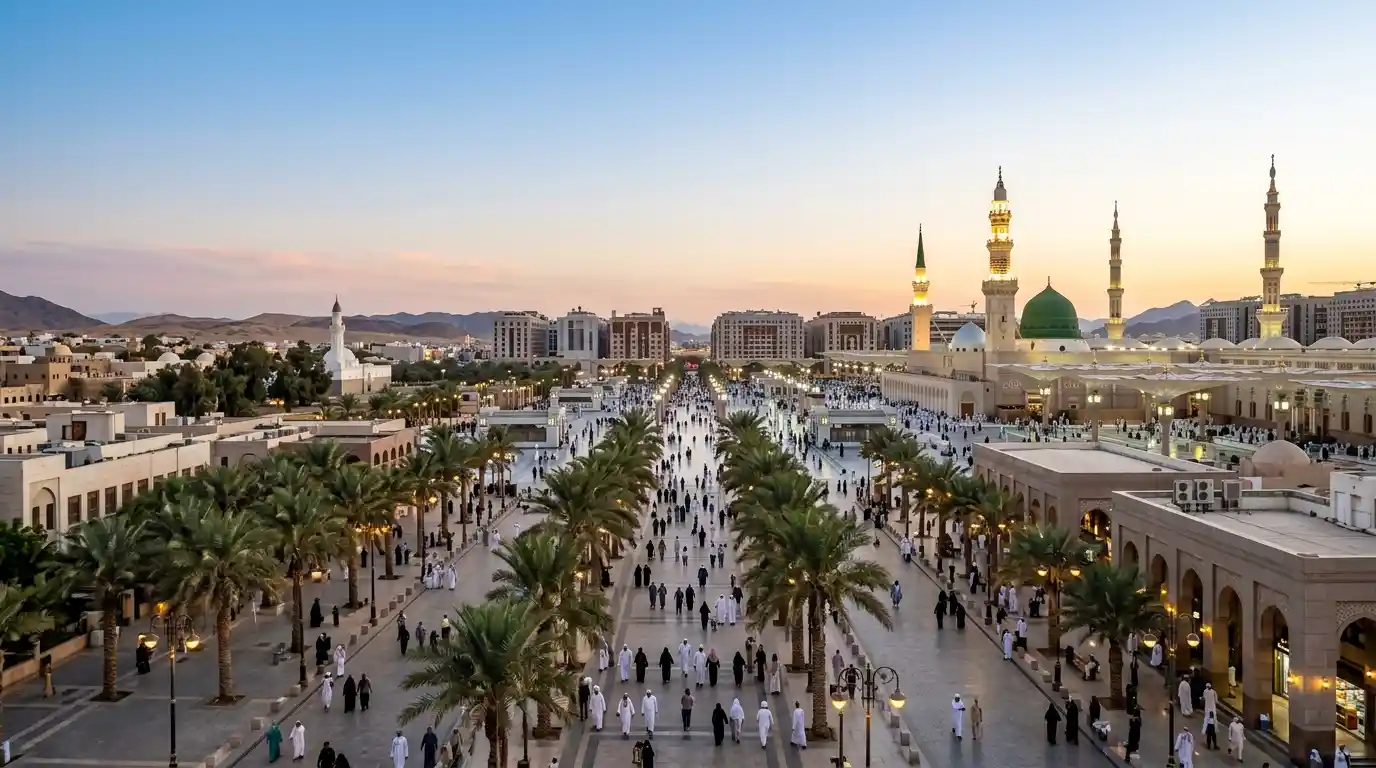
Best Time to Visit Madinah: Weather, Crowds & Experiences
For most travelers, the best time to visit Madinah is from December through February, when the city’s cooler winter conditions make walking, outdoor transfers and visits beyond the central mosque area considerably more comfortable than during the intense summer heat. November and March can also work very well as transitional alternatives, especially for travelers who prefer warmer afternoons, but religious timing can matter more than climate for pilgrims whose journey is centered on Ramadan, Hajj-related travel or a specific period of worship.
Madinah is fundamentally different from an ordinary sightseeing destination. Al Madinah Al Munawwarah holds profound religious importance for Muslims as the city of the Prophet Muhammad (peace be upon him), and the Ministry of Hajj and Umrah describes the Prophet’s Mosque as the second holiest site in Islam. The city also welcomes very large numbers of visitors throughout the year, so deciding on the best time to visit Madinah involves balancing temperature, worship priorities, crowd density, accommodation demand and the rhythm of the Islamic calendar rather than simply choosing the coolest month.
Current Visit Saudi destination information illustrates the climatic contrast clearly: predicted winter temperatures are approximately 8–26°C, while summer can reach roughly 26–45°C. Spring can rise to about 41°C and autumn to about 38°C, although actual conditions vary by day.
For broad city orientation, begin with the Madinah travel guide. Once you have selected your travel period, the Madinah itinerary can help arrange worship, historical visits and other experiences without making the trip unnecessarily rushed.
Best Time to Visit Madinah at a Glance
| Travel period | General conditions | Best suited to |
|---|---|---|
| December–February | Coolest and most comfortable | First visits, walking, families, heritage |
| November | Warm-to-mild transition | Visitors wanting warmer days |
| March | Increasing warmth | Mixed indoor and outdoor plans |
| April | Noticeably hotter | Early and late outdoor activity |
| May–September | Very hot | Worship-focused trips with heat planning |
| October | Heat gradually easing | Warm-weather travelers |
| Ramadan | Spiritually significant, very high demand | Worship-centered visits |
| Major pilgrimage periods | Heavy visitor movement | Religious journeys where timing outweighs weather |
The best time to visit Madinah therefore depends on whether comfort or religious purpose is your main priority. A general leisure traveler has more freedom to choose winter; a pilgrim may intentionally accept hotter weather or greater crowds because the spiritual timing matters more.
December Through February Is the Best Overall Weather Window
For visitors who can choose freely, December through February is the best time to visit Madinah for general comfort.
Visit Saudi’s current destination information gives the winter period a broad predicted range of approximately 8–26°C, far below summer conditions that can reach the mid-40s Celsius.
The difference becomes especially noticeable because Madinah involves considerable walking. Even if your accommodation is close to the central area, movement between hotel entrances, mosque courtyards, transport pickup points, restaurants and other sites adds up over the course of the day.
Cool weather provides greater flexibility.
You can leave your hotel without immediately planning the shortest shaded route, spend more time outside after prayers and visit historical or cultural sites without making every decision around extreme heat.
For travelers hoping to see more than the central religious area, the cooler period also makes the things to do in Madinah easier to combine naturally.
Winter Is Especially Good for Walking
Walking comfort is one of the strongest reasons December through February is the best time to visit Madinah for many travelers.
The courtyards surrounding the Prophet’s Mosque are extensive, and Saudi reference material notes the enormous scale of the mosque and surrounding courtyard infrastructure, including large shaded areas designed to assist worshippers and visitors.
Those facilities provide substantial protection, but they do not remove the effect of outdoor temperature.
Cooler conditions make the journey between accommodation, prayer areas, shops and transport noticeably easier, particularly for older travelers, families with children and anyone planning several days in the city.
Travelers deciding how close they need to stay can use where to stay in Madinah after choosing the season.
Winter Mornings and Evenings Can Feel Genuinely Cool
Do not assume that Saudi Arabia means hot weather every hour of the year.
With predicted winter temperatures dropping into single digits at the cooler end, Madinah mornings and late evenings can feel surprisingly fresh, especially if you spend substantial time outside.
A light jacket, sweater or shawl can therefore be useful.
The best time to visit Madinah for warm-weather travelers may be toward the edges of winter rather than its coolest portion, particularly if you dislike chilly early-morning conditions.
However, for travelers who intend to walk extensively, cool weather is normally easier to manage than extreme heat.
November Is a Strong Transitional Choice
November can be one of the best times to visit Madinah when you want conditions warmer than midwinter but still considerably more manageable than summer.
Autumn temperatures are falling toward the winter pattern, allowing visitors greater outdoor flexibility as the season progresses.
Because exact daily conditions vary, November should not be treated as identical to December or January. Earlier periods may still feel quite warm, particularly during exposed afternoon activity.
The practical advantage is balance.
Travelers can structure a Madinah visit around prayer, historical sightseeing and evening dining without the same level of heat management required in summer.
If your interests extend strongly into history, use historical places in Madinah once you know how much outdoor sightseeing your chosen conditions will support.
March Is Another Useful Shoulder Period
March can also be a strong choice for the best time to visit Madinah, particularly for travelers who prefer warmer afternoons.
Spring conditions rise rapidly in western Saudi Arabia. Visit Saudi currently gives a broad predicted spring range of about 18–41°C, demonstrating that the season can move from pleasantly warm conditions toward serious heat.
That makes timing important.
Earlier and cooler conditions can support long walking days, whereas warmer periods may require more breaks and greater reliance on air-conditioned transport.
March is consequently best approached as a transition month rather than a guaranteed extension of winter.
April Becomes More Heat-Sensitive
April can still work well, but it is no longer the easiest answer to the question of the best time to visit Madinah.
Outdoor movement increasingly benefits from earlier starts and later evening activity, while midday becomes less appealing for long sightseeing routes.
Religious visits remain entirely practical because worship is not dependent on sightseeing weather, but visitors planning additional museums, heritage environments or walking routes should begin treating heat as a major logistical factor.
This is where indoor things to do in Madinah can become useful as part of a balanced itinerary.
Summer Is Very Hot
For travelers whose primary priority is comfort, summer is generally not the best time to visit Madinah.
Visit Saudi currently lists predicted summer temperatures of approximately 26–45°C, while the National Center for Meteorology describes the Madinah Region as having a continental climate that is hot in summer.
Temperatures in the 40s materially change how a visitor should plan.
Long walks become more demanding, exposed sightseeing should be minimized during the hottest part of the day, and transport efficiency matters considerably more.
This does not mean Madinah should be avoided when religious travel requires a summer visit. It means the itinerary should respect the climate rather than pretending the season has no effect.
How to Handle a Hot-Weather Visit
When the best time to visit Madinah for your religious schedule falls during hot weather, reorganize the day rather than attempting to follow a winter-style sightseeing plan.
Use the cooler parts of the day for longer outdoor movements and place rest, meals or indoor experiences around periods of stronger heat.
Keep drinking water available and avoid unnecessary exposed walking merely to save a short vehicle journey.
The Prophet’s Mosque itself provides extensive visitor infrastructure, including shaded courtyards, Zamzam water distribution, wheelchair support and accessibility services.
Those services help, but visitors should still be realistic about personal heat tolerance.
For transport planning beyond the immediate mosque surroundings, use getting around Madinah rather than deciding only after the weather becomes uncomfortable.
Ramadan Changes the Meaning of “Best”
For many Muslims, Ramadan can be the best time to visit Madinah spiritually even though it is not necessarily the easiest period logistically.
The Ministry of Hajj and Umrah specifically warns that demand rises strongly during Ramadan, particularly during the final ten nights, and advises visitors to monitor crowd density and plan transport and religious visits carefully.
This is a critical distinction.
A traveler choosing purely according to weather might prefer winter. A worshipper choosing according to spiritual priorities may deliberately choose Ramadan regardless of temperature or crowd levels.
Both decisions are valid because they answer different questions.
The best time to visit Madinah should therefore never be presented as if climate automatically outweighs religious purpose.
Expect Much Higher Demand During the Final Part of Ramadan
The final portion of Ramadan requires especially deliberate planning.
Official Ministry guidance states that crowd density at the Prophet’s Mosque increases during the last ten days and the odd-numbered nights.
Accommodation can be harder to secure, transportation becomes more sensitive to demand, and walking routes around the central area may take longer.
If this is when you intend to travel, book the major fixed parts of the trip earlier than you would for an ordinary week.
The best time to visit Madinah for a peaceful, low-crowd sightseeing experience is therefore generally not the most sought-after portion of Ramadan.
For visitors prioritizing worship, however, those crowds are part of a religiously significant period rather than simply an inconvenience.
Friday Has Its Own Crowd Pattern
Even outside Ramadan, Friday can change how the central part of Madinah feels.
The Ministry of Hajj and Umrah notes that worshippers are especially keen to perform Friday prayer at the Prophet’s Mosque and that crowding can become significant, particularly during religiously preferred seasons.
If your objective is worship, that timing has obvious significance.
If your objective is photography, relaxed movement or visiting another site, you may want to schedule those activities outside the busiest prayer-related movement periods.
The best time to visit Madinah cannot therefore be understood only at the level of months. Daily religious rhythms matter as well.
Hajj-Related Travel Can Increase Visitor Movement
Madinah is not one of the ritual sites where the central Hajj rites take place, but many international pilgrims include the city before or after their pilgrimage.
The Ministry of Hajj and Umrah describes Madinah as one of the principal destinations receiving millions of Muslim visitors and integrates the city closely into the broader pilgrimage service system.
That means periods surrounding major pilgrimage movements can affect transport, accommodation and visitor density.
If your journey is primarily a general city visit rather than a pilgrimage, you may prefer a quieter period.
If your journey is connected to Hajj, religious timing naturally takes precedence over ordinary tourism-season optimization.
The Islamic Calendar Moves Through the Seasons
Ramadan and Hajj do not remain in the same Gregorian months.
They follow the Islamic lunar calendar and therefore move through different weather conditions over time.
This is especially important for an evergreen article about the best time to visit Madinah.
Never assume that Ramadan always means extreme heat or that Hajj always falls within one particular season. Check the relevant religious dates and current weather for your actual travel period.
The relationship between climate and pilgrimage changes continuously.
Best Time to Visit Madinah for the Prophet’s Mosque
For maximum physical comfort, the cooler winter period is the best time to visit Madinah for spending long periods around the Prophet’s Mosque.
However, the religious significance of visiting the mosque is not seasonal.
Muslim visitors may prefer Ramadan or another spiritually meaningful period despite greater crowding, and prayer times naturally shape movement throughout every day.
The Ministry of Hajj and Umrah emphasizes respectful conduct around the Prophet’s Mosque and advises visitors to move calmly, avoid raising voices and allow space for others during busy periods.
This etiquette is more important than sightseeing convenience.
Plan Al-Rawdah Al-Sharifah Separately
If praying in Al-Rawdah Al-Sharifah is important to your visit, do not assume ordinary mosque access automatically provides access to the Rawdah.
Current Ministry of Hajj and Umrah guidance states that prayer appointments for Al-Rawdah Al-Sharifah are booked through the Nusuk application and that visitors should adhere strictly to the scheduled permit time.
This requirement affects the best time to visit Madinah because your itinerary should remain flexible around the permit you actually obtain.
Do not schedule a distant activity immediately before the appointment.
During highly demanded religious periods, plan even more conservatively around transport and crowds.
Best Time to Visit Madinah for Quba
Quba is rewarding throughout the year, but cooler months make the surrounding area easier to explore on foot.
Quba Mosque holds exceptional significance in Islamic history as the first mosque built in Islam. Current official tourism information continues to present it among Madinah’s principal sacred sites.
The best time to visit Madinah for a broader religious journey that includes Quba is therefore usually winter when viewed purely from a comfort perspective.
However, worship and religious significance remain independent of season.
Travelers should dress respectfully, avoid obstructing worshippers and allow prayer activity to take priority over photography.
Best Time to Visit Madinah for Historical Sightseeing
December through February is the strongest period for travelers who want to explore historical Madinah beyond the central mosque area.
The Ministry of Hajj and Umrah currently highlights religious landmarks, historical places, museums and exhibitions as part of the wider visitor experience.
Some of these experiences are indoors, while others require vehicle transfers and outdoor walking.
Cool weather makes combining several places considerably easier.
The exact site selection belongs in historical places in Madinah, while this page remains focused on when conditions are most favorable.
Best Time to Visit Madinah for Families
For most families, December through February is the best time to visit Madinah because children and older relatives generally cope better with long days when outdoor temperatures are moderate.
This is particularly important for families staying farther from the central area or combining worship with sightseeing.
The Prophet’s Mosque provides accessibility support, including wheelchairs, mobility vehicles, elevators and designated services for visitors with disabilities.
These facilities improve accessibility, but comfortable weather still reduces physical strain.
Families planning age-specific activities can use Madinah with kids rather than turning this seasonal guide into a family attraction list.
Best Time to Visit Madinah for Older Travelers
Cooler months deserve even greater priority when traveling with elderly relatives.
Heat can make repeated outdoor transfers more tiring, and busy religious periods can require additional walking or waiting even when transport is well organized.
Winter allows more flexibility around rest.
Accommodation location becomes particularly important, so travelers should consider proximity and accessibility alongside price.
Use where to stay in Madinah when deciding how much walking is realistic for your group.
The best time to visit Madinah for an older traveler should reflect health, mobility and worship priorities rather than following a generic tourism recommendation mechanically.
Best Time to Visit Madinah for Lower Crowds
There is no reliable month-by-month crowd index that can tell you exactly when Madinah will feel quiet.
Religious calendars matter more than ordinary tourism seasonality.
Ramadan, particularly its final portion, produces high demand. Friday prayer can increase crowding around the Prophet’s Mosque. Pilgrimage travel periods can also affect hotels and transportation.
If your priority is a quieter trip, avoid the most obvious high-demand religious periods when your schedule permits and favor ordinary weekdays outside major holiday windows.
The best time to visit Madinah for lower crowds may therefore differ from the best period for spiritual atmosphere.
Best Time to Visit Madinah for Photography
Winter is generally the easiest period for photography because you can remain outside longer.
Early light and the transition into evening can be particularly attractive around the city, but photographers should remember that religious sites are functioning places of worship rather than sets.
Avoid obstructing movement, closely photographing worshippers without permission or treating prayer activity as spectacle.
The best time to visit Madinah for architectural photography is a period when comfortable weather allows patience while respectful behavior remains the priority.
For broader subject selection, things to do in Madinah can help identify other cultural and historical environments.
Best Time to Visit Madinah on a Budget
There is no dependable rule that one weather season always produces the cheapest Madinah trip.
Accommodation prices can respond strongly to religious demand, holidays, weekends and proximity to the Prophet’s Mosque.
A very hot period may sometimes offer more accommodation flexibility, but that should not be assumed without checking actual prices.
Likewise, excellent winter weather can overlap with ordinary lower-demand periods or with busy travel windows.
The best time to visit Madinah on a budget is therefore the period where live accommodation prices, religious timing and weather intersect favorably.
Compare several dates rather than relying on a generic “low season” label.
Accommodation Demand Matters More Than in Many Cities
Madinah’s hotel market is closely tied to religious travel.
A property near the Prophet’s Mosque can save substantial walking time, especially during heat or heavy crowding, so price should not be the only consideration.
A slightly more expensive central location may offer better overall value to travelers who would otherwise rely on repeated transport.
This becomes particularly important during Ramadan or other high-demand periods.
The where to stay in Madinah guide covers those area tradeoffs separately.
Transport Planning Changes by Season
The best time to visit Madinah affects how much you are likely to rely on vehicles.
During winter, travelers may be comfortable walking farther within the central area.
During hotter months, taxis, ride-hailing, buses or other transport become more valuable for journeys that might otherwise seem walkable.
The Ministry of Hajj and Umrah currently identifies private cars, trains, flights, buses, taxis and ride-hailing among the major ways pilgrims and visitors move to and around Madinah.
Use getting around Madinah for the full transport decision rather than repeating mode-by-mode logistics here.
Ramadan Requires Earlier Transport Planning
Official Ministry guidance specifically notes high transport demand during Ramadan, particularly during the final ten days, and recommends early booking.
That applies especially to travelers connecting Madinah with another pilgrimage destination.
Do not build a tightly timed itinerary that depends on every transfer operating with ordinary-week flexibility during a high-demand religious period.
Allow buffers.
The best time to visit Madinah for worship may be a busy period, but strong logistical preparation can make that choice considerably easier.
Check Current Weather Shortly Before Travel
Even when you choose the best time to visit Madinah based on seasonal conditions, check the short-term forecast.
The National Center for Meteorology maintains dedicated forecasts and warnings for the Madinah Region, covering temperature, wind, visibility and active weather alerts.
Wind and dust can occasionally affect visibility and outdoor comfort.
A winter trip is therefore not guaranteed to produce identical weather every day.
Use seasonal planning to choose the broad period and the live official forecast to shape each actual day.
What to Wear in Winter
Winter visitors should prepare for warm sunshine and noticeably cooler mornings or evenings.
Light, modest daytime clothing remains useful, but a sweater, cardigan or jacket can make early prayer periods and late outdoor time more comfortable.
Comfortable footwear is particularly important because even a worship-centered trip can involve substantial walking.
Respectful dress is essential around religious sites regardless of temperature.
What to Wear During Hot Weather
During summer and hotter shoulder periods, choose breathable, loose and modest clothing suitable for intense heat.
Sun protection becomes especially important during outdoor transfers.
Carry water, rest when necessary and do not allow a sightseeing schedule to take priority over physical comfort.
The best time to visit Madinah during summer is often the cooler portion of each day rather than one particular week.
That daily adjustment matters more than trying to overcome the climate through endurance.
Building a Seasonal Madinah Itinerary
Once you know the best time to visit Madinah for your priorities, adapt the route accordingly.
In winter, longer outdoor blocks can fit naturally between prayer periods.
During transitional months, concentrate outside activity earlier or later according to the day’s forecast.
In summer, reduce optional midday sightseeing and prioritize worship, indoor experiences and efficient transport.
During Ramadan, the rhythm of worship and evening activity should lead the itinerary rather than ordinary sightseeing expectations.
For general route structure, use the Madinah itinerary. A short trip can be planned through one day in Madinah, while 2 days in Madinah and 3 days in Madinah provide longer duration-specific frameworks.
Leave Room for Rest
Madinah is a place where many visitors intentionally spend significant time in worship, and an itinerary should respect that purpose.
Do not fill every gap between prayers with another sightseeing transfer.
Rest can be part of good planning, particularly when temperatures are high, crowds are heavy or the trip includes older family members.
A slower journey can also make the spiritual experience more meaningful.
Travelers who want additional low-cost options around a relaxed schedule can use free things to do in Madinah.
Restaurants and Shopping Can Fill Hotter Periods
When outdoor conditions become uncomfortable, meals and shopping can provide useful itinerary flexibility.
Rather than undertaking a long exposed transfer at midday, use the warmer period for rest, food or appropriate indoor activity, then return outside later.
The best restaurants in Madinah guide can handle venue selection, while shopping in Madinah covers retail separately.
This approach keeps the best-time page focused on seasonal decisions rather than creating a restaurant or shopping directory.
Consider Day Trips Only After Madinah’s Core Experience
Cooler weather also makes longer excursions easier.
However, visitors should not allow day trips to crowd out the central purpose of a Madinah stay.
Use the day trips from Madinah guide if you have enough time after worship and city-based experiences.
The best time to visit Madinah for a wider regional trip is generally winter because longer transfers and outdoor stops become easier.
For a pilgrimage-centered stay, however, remaining in Madinah rather than maximizing excursions may be the more appropriate choice.
Practical Seasonal Planning Tips
Choose December through February when weather comfort is your highest priority.
Consider November or March if you prefer warmer daytime conditions.
Expect spring temperatures to rise quickly and summer heat to become intense.
During hot weather, shift optional outdoor activity away from the hottest part of the day.
Expect Ramadan—particularly its final ten nights—to bring substantially higher demand around the Prophet’s Mosque.
Expect Friday prayer to increase crowd density, particularly during religiously favored periods.
Book Al-Rawdah Al-Sharifah through the Nusuk application and respect the assigned appointment time.
Check current transport, accommodation and mosque guidance before high-demand religious travel.
Use the official meteorological forecast shortly before the trip rather than relying entirely on seasonal averages.
For wider national planning beyond Madinah, use the Saudi Arabia travel guide.
Frequently Asked Questions About the Best Time to Visit Madinah
What is the best time to visit Madinah overall?
For travelers choosing primarily according to weather, the best time to visit Madinah is December through February. Current Visit Saudi information places predicted winter temperatures around 8–26°C, compared with much hotter conditions during spring and summer.
Is December a good time to visit Madinah?
Yes. December falls within the coolest travel period and is well suited to long outdoor walks, historical sightseeing and travelers who want to minimize heat exposure.
Is January a good time to visit Madinah?
Yes. It is within the core cool season and is generally one of the easiest periods for walking and spending extended time outdoors. Bring a light layer for cooler mornings and evenings.
Is February a good time to visit Madinah?
Yes. February remains within the cool winter travel window and works particularly well for visitors combining worship with substantial walking or sightseeing.
Is Ramadan the best time to visit Madinah?
It can be spiritually meaningful for Muslim visitors, but it is also a high-demand period. The Ministry of Hajj and Umrah specifically warns that crowd density increases during the last ten days and odd-numbered nights of Ramadan.
Is summer too hot for Madinah?
Summer is very hot, with current Visit Saudi information showing predicted temperatures reaching about 45°C. Religious travel remains possible, but optional sightseeing should be adapted around heat, rest and efficient transportation.
When is Madinah least crowded?
There is no reliable official quiet-month ranking. Crowd levels depend heavily on Ramadan, pilgrimage movements, Friday prayer, holidays and other religious travel patterns. Ordinary weekdays outside major religious-demand periods are generally the more practical choice when lower crowds matter.
Do I need a permit for Al-Rawdah Al-Sharifah?
Current Ministry of Hajj and Umrah guidance states that prayer appointments for Al-Rawdah Al-Sharifah are booked through the Nusuk application. Visitors should follow the assigned appointment time.
Choosing the Best Time to Visit Madinah
For a traveler who can choose freely according to comfort, December through February is the best time to visit Madinah. Cooler temperatures make walking easier, reduce the physical strain of outdoor transfers and create far more flexibility for combining worship with historical and cultural experiences. Current Visit Saudi climate guidance strongly supports this winter advantage, with predicted temperatures substantially lower than during the intense summer period.
The best time to visit Madinah changes when the purpose of the journey changes. Ramadan may be spiritually preferable despite far heavier crowds. Pilgrimage-connected visitors may need to travel according to religious schedules rather than climate. Families and older travelers may place greater emphasis on winter comfort, while visitors with fixed summer dates can still have a meaningful journey by shifting unnecessary outdoor activity away from the strongest heat.
Above all, Madinah should be approached differently from an ordinary city break. The Ministry of Hajj and Umrah emphasizes tranquility, dignity and consideration for other worshippers around the Prophet’s Mosque, especially when visitor density is high.
Choose your season around the purpose of the journey, not simply a tourism calendar. Then use the Madinah itinerary to structure your stay, where to stay in Madinah to reduce unnecessary transfers and getting around Madinah to prepare for the conditions you are likely to encounter.
When weather, religious timing and practical logistics are considered together, the best time to visit Madinah becomes much easier to identify—and the resulting journey can remain focused on what matters most to the individual visitor.