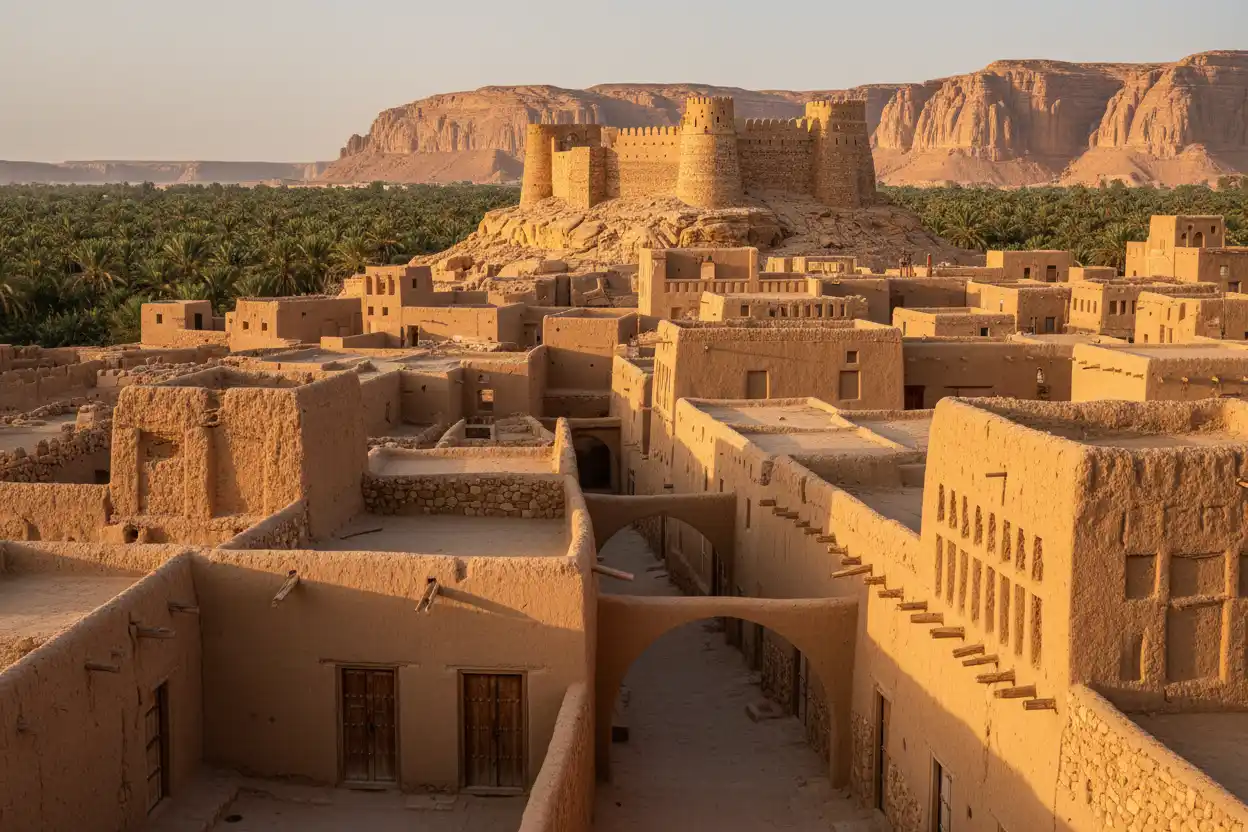
AlUla Old Town: Visitor Guide, Highlights & Practical Tips
AlUla Old Town is the historic mudbrick settlement at the heart of modern AlUla, a dense maze of narrow lanes and traditional houses whose story reaches back almost a millennium. Unlike Hegra’s monumental Nabataean tombs or Elephant Rock’s natural sandstone form, AlUla Old Town reveals how people actually lived, traded, worshipped, welcomed travelers and organized daily life within the Oasis during a much later period of the region’s history.
For most visitors, AlUla Old Town is one of the easiest major attractions to incorporate into a trip because the public area is currently free to enter, pedestrian-friendly, connected naturally with AlJadidah and the Oasis, and increasingly lively from the afternoon into the evening. Travelers who want deeper historical interpretation can book a guided Rawi tour, which provides access to selected heritage spaces not normally open during independent exploration, including access associated with AlUla Fort.
That combination makes AlUla Old Town unusually flexible. You can treat it as a relaxed walk between other reservations, spend several hours exploring the surrounding heritage district, or use a guided tour to understand the site’s architecture, pilgrimage history, trade routes and community traditions in greater depth.
If this is your first trip, use the broader AlUla travel guide to understand where the historic district sits within the destination, while the guide to things to do in AlUla can help you decide how much of your sightseeing time to dedicate to culture, archaeology, nature and contemporary attractions.
AlUla Old Town at a Glance
| Visitor question | Practical answer |
|---|---|
| What is it? | A historic mudbrick settlement in central AlUla |
| Historical character | Settlement with origins approaching a millennium |
| Public entry | Currently free |
| Best way to explore | Independent walk or guided Rawi tour |
| Guided tour duration | About 1–1.5 hours |
| Tour language | English and Arabic |
| Tour meeting point | Old Town Visitor Centre |
| Parking | Free parking currently available nearby |
| Main character | Mudbrick lanes, historic houses, fort, market, heritage atmosphere |
| Best time for atmosphere | Late afternoon into evening |
| Good pairing | Oasis and AlJadidah |
| Family suitability | Public area is family-friendly; check individual tour needs |
| Accessibility | Guided tour currently listed as unsuitable for wheelchairs/strollers |
Current operating hours, tour prices, restoration access and special-event arrangements can change, so verify live information before building a tightly timed visit around them.
Why AlUla Old Town Matters
AlUla Old Town matters because it helps connect the ancient history of the valley with a much more recent period of continuous settlement.
The site developed as a compact community of mudbrick houses, pathways, religious buildings, defensive elements and markets. Official Experience AlUla information describes a settlement associated with the 12th century, positioned on historic incense trading routes and the pilgrimage path linking Damascus with Makkah. Fourteen gates once controlled movement through the settlement, while a fort overlooking the town provided a defensive vantage point.
This makes AlUla Old Town fundamentally different from Hegra. Hegra tells an ancient Nabataean story through monumental tombs and archaeology; Old Town tells a later story through domestic architecture, streets, commerce, religious life and community memory.
Seeing both prevents AlUla from becoming reduced to one historical period.
A Settlement Built for Density
One of the first things you notice in AlUla Old Town is how closely its buildings sit together.
Mudbrick houses line narrow lanes with relatively little open space between them, creating an almost continuous defensive mass from the outside. This compact construction made sense in an environment where security, shade, community proximity and efficient use of land all mattered.
The architecture also creates a striking walking experience today.
Instead of standing in front of one monumental building, you move through a network of walls, alleys, doorways and changing light. The attraction is therefore spatial rather than object-based.
AlUla Old Town rewards wandering.
Why the Buildings Were Made From Mudbrick
Mudbrick is one of the most important traditional building materials in arid regions because the raw materials can be locally sourced and thick earthen walls help moderate interior temperature.
In AlUla Old Town, the architecture also reflects the relationship between settlement and Oasis agriculture. Construction materials, shade, street orientation and building density evolved within the environmental conditions of the valley.
Visitors should resist the temptation to judge mudbrick ruins by the standards of stone monuments.
These structures were homes, shops and community spaces rather than ceremonial façades intended to survive untouched for thousands of years.
Their fragility is part of the conservation challenge.
AlUla Fort Overlooks the Settlement
One of the most recognizable features of AlUla Old Town is the fort rising above the historic settlement.
Experience AlUla describes the fort as approximately 45 metres high, with origins around the 10th century, positioned as a defensive lookout over the town and Oasis.
The elevated position helps explain the relationship between the settlement and its surroundings.
From higher ground, the contrast becomes much clearer: dense mudbrick architecture below, agricultural land and palms nearby, then sandstone formations enclosing the broader valley.
Current guided Old Town tours include access associated with the top of AlUla Fort, providing a perspective unavailable through every independent route.
Can You Visit AlUla Fort Independently?
Do not assume that every part of the fort and heritage zone is freely accessible.
Although general entry to AlUla Old Town is currently free, the official guided tour specifically includes entrance to parts of Old Town restricted to the public, including access to the top of the fort.
That distinction is important.
Independent exploration gives you the atmosphere, public lanes, market areas and surrounding district, while a guided tour provides additional controlled heritage access and interpretation.
Follow on-site barriers and instructions rather than trying to reproduce access seen in older photographs.
Is AlUla Old Town Free to Visit?
Yes. Current official guidance states that AlUla Old Town is free and open to all.
You do not need to purchase a guided tour simply to experience the public heritage area.
This makes AlUla Old Town one of the most useful attractions for visitors balancing expensive archaeological tours with lower-cost sightseeing. The broader free things to do in AlUla guide can help build more of these experiences into the trip.
The paid tour should therefore be viewed as an interpretive upgrade rather than an admission requirement.
Should You Book the Old Town Tour?
Book the guided tour if historical interpretation matters to you.
The current Old Town Tour uses a local Rawi storyteller to explain community life, trade, pilgrimage and the architecture of the settlement while moving through lanes and selected heritage spaces. The experience currently lasts around one to one-and-a-half hours and includes access to some areas restricted during ordinary public visits.
For history-focused travelers, that added interpretation can significantly improve the visit.
For travelers who have already completed several guided archaeological tours and want a more relaxed afternoon, independent exploration may create better balance.
Neither approach is automatically superior.
What Is a Rawi Guide?
A Rawi is a storyteller who interprets AlUla’s heritage through historical knowledge, local narratives and cultural context.
At AlUla Old Town, the Rawi-led experience focuses on how families lived, how trade and pilgrimage shaped the settlement and how architectural spaces functioned within everyday community life.
That storytelling approach suits the site particularly well because many individual walls or passageways do not communicate their former use automatically.
Context turns ruins into a settlement.
How Long Is the Guided Tour?
The current official Old Town Tour is listed at approximately one to one-and-a-half hours.
Do not treat that as the maximum amount of time to allocate to the area.
The guided experience can be followed by Market Street, cafés, AlJadidah or an Oasis walk, so AlUla Old Town can easily become a substantial afternoon and evening district rather than a single one-hour activity.
Visitors following an AlUla itinerary should think of Old Town as a flexible geographic cluster.
Do You Need to Book the Guided Tour in Advance?
Advance booking is sensible if the tour is important to you.
The current experience has a maximum group size of 15 and scheduled morning and afternoon departures, which means capacity is inherently limited.
If you are happy to explore independently, the situation is much more flexible because general Old Town access does not depend on securing a tour slot.
This distinction is useful during busy event periods.
Reserve the structured experience first; keep the independent walking portion adaptable.
Old Town Market Street
Old Town Market Street adds contemporary life to the heritage setting.
Current official information describes a year-round, unguided market area where visitors can browse handicrafts, clothing, jewelry, art, local food, coffee and souvenirs. No ticket is currently required.
That active commercial layer matters because AlUla Old Town is not presented simply as an abandoned ruin.
The district combines preserved heritage with shops, cafés, restaurants and ongoing visitor activity.
This makes it especially attractive in the late afternoon and evening.
When Is Market Street Open?
The current official Market Street schedule lists daily opening periods in the morning and again from mid-afternoon through midnight, although schedules are updated periodically.
Because retail and food operating times can change, do not plan around the final hour without checking current information.
The important practical point is that the district becomes much livelier later in the day.
That is why a late-afternoon arrival often provides more atmosphere than a very early visit.
Morning or Evening: Which Is Better?
Morning is better for travelers who prioritize quiet streets, architectural detail and lower activity levels.
Late afternoon and evening are better for atmosphere.
Experience AlUla currently notes that most of the district begins operating earlier in the day but becomes noticeably livelier from mid-afternoon onward, with shops and restaurants staying open later.
For many first-time travelers, the ideal sequence is to arrive in the later afternoon, explore the heritage area in daylight, then continue into Market Street or nearby AlJadidah as the district becomes more active.
Why Late Afternoon Works So Well
Late-afternoon light improves the texture of mudbrick walls and reduces some of the harsh contrast common around midday.
It also lets you watch AlUla Old Town shift from a heritage attraction into an evening social district.
Cafés begin filling, shops stay active, lighting becomes more atmospheric and nearby AlJadidah provides an easy continuation.
Travelers using the guide to things to do in AlUla at night will find Old Town one of the easiest daytime attractions to extend naturally after dark.
AlJadidah Is the Natural Next Stop
AlJadidah Arts District sits adjacent to AlUla Old Town and is one of the easiest places to combine with it.
Current official guidance describes AlJadidah as free to enter, pedestrian-friendly and filled with murals, galleries, cultural venues, cafés, shops, food trucks and creative spaces. The district becomes particularly lively around late afternoon, with many businesses continuing into the evening.
The two districts are pedestrian-only and within easy walking distance of one another.
This is one of the strongest walkable combinations anywhere in AlUla.
The Oasis Is the Other Natural Pairing
AlUla Old Town also connects conceptually and geographically with the Oasis.
The settlement cannot be understood properly without the agricultural landscape that supported it. Palm groves, farms and ancient water systems supplied food, shade and economic value to generations of residents.
That relationship is visible from the fort and through the transition from built heritage into cultivated land.
For visitors interested in how human settlement adapted to the desert, Old Town plus Oasis is a stronger pairing than two unrelated landmarks.
Old Town and Hegra Tell Different Stories
Visitors sometimes ask whether seeing Hegra makes AlUla Old Town unnecessary.
It does not.
Hegra is ancient, monumental and Nabataean.
AlUla Old Town is later, domestic and community-oriented.
One explains elite funerary architecture and caravan-era archaeology; the other explains houses, streets, pilgrimage, trade and everyday settlement.
If you care about AlUla’s historical depth, both belong in the trip.
Old Town and Elephant Rock Also Pair Well
The combination with Elephant Rock is practical for another reason: contrast.
Spend the afternoon walking AlUla Old Town and the Oasis, then move toward Elephant Rock for sunset.
You transition from dense human-built heritage to open desert geology.
This sequence also works well logistically in the one day in AlUla itinerary because the natural landmark is most attractive later in the day.
How Old Is AlUla Old Town?
Official visitor information places the settlement’s main historical development around the 12th century and describes its origins as approaching a millennium.
The fort overlooking it is older, with official material tracing its defensive origins to around the 10th century.
The important point is that AlUla Old Town belongs to a much later historical layer than Hegra or Dadan.
AlUla’s value comes partly from this extraordinary chronological range.
Why Was the Town Important for Pilgrims?
AlUla occupied an important position on the pilgrimage route from Damascus toward Makkah.
Travelers moving along that route needed places where they could find water, food, security, markets and accommodation.
A productive Oasis and established settlement gave AlUla strategic importance beyond the local community.
Official destination material specifically identifies Old Town as a key settlement on this pilgrimage path.
That history helps explain why trade and hospitality became central to the town’s identity.
The Fourteen Gates
Experience AlUla states that the historic settlement once had 14 gates.
These controlled movement into a settlement whose closely packed exterior buildings could function almost like a continuous defensive boundary.
The gates reinforce the idea that AlUla Old Town should be understood as an organized urban environment rather than a random collection of mudbrick houses.
Its density had purpose.
Conservation and Restoration
Mudbrick heritage requires ongoing maintenance because earthen architecture is vulnerable to erosion, water, structural failure and inappropriate rebuilding.
Visitors will therefore encounter areas at different stages of conservation and restoration.
The official guided experience specifically includes restored heritage spaces and provides insight into how AlUla Old Town is being safeguarded.
Do not interpret restricted access or visible restoration as evidence that the site is incomplete.
Conservation is part of how fragile heritage remains available at all.
Should You Touch the Walls?
Treat the historic fabric carefully.
Mudbrick is far more vulnerable to repeated physical contact than stone appears to be, and old walls can shed or erode even when damage is not immediately obvious.
Stay on visitor paths, respect barriers and do not climb onto ruined walls or architectural remains for photographs.
The safest assumption at AlUla Old Town is that preservation takes priority over getting closer.
What Should You Wear?
Comfortable outdoor clothing and closed-toe walking shoes are recommended for the guided Old Town experience, together with sun protection such as a hat, sunglasses and sunscreen.
The public district does not require specialist hiking clothing, but you will spend meaningful time walking on outdoor surfaces and through pedestrian lanes.
Official visitor guidance also notes that women do not generally need an abaya or headscarf for ordinary Old Town exploration, although places of worship require respectful dress.
Choose practical, modest clothing suitable for the weather and setting.
Is AlUla Old Town Good in Hot Weather?
Yes, but adjust your timing.
Narrow streets and shaded sections can be more comfortable than entirely exposed desert landscapes, but AlUla Old Town remains an outdoor walking attraction.
During hotter periods, late afternoon and evening become increasingly attractive.
Use Arabian Nova’s best time to visit AlUla guide for the seasonal decision, while AlUla weather by month provides the more detailed climate reference.
Weather should influence when you walk, not whether you understand the site.
Is AlUla Old Town Good in Winter?
Yes.
Cooler conditions make longer walking easier, particularly if you plan to combine the district with the Oasis and AlJadidah.
However, desert evenings can become cool.
Current Market Street guidance specifically recommends bringing a warm jacket for chilly early mornings and nights.
If you plan to stay through dinner or late-evening shopping, carry a layer rather than dressing only for midday sunshine.
Is the Guided Tour Suitable for Children?
Current official tour information states that all ages are welcome.
Whether children enjoy the full interpretation depends on their age and interest in history.
One advantage of AlUla Old Town for families is flexibility: if younger children become restless, you can transition from a structured tour into Market Street, food, open pedestrian areas or nearby AlJadidah.
Families planning the complete destination should use AlUla with kids for broader age-specific choices.
What About Wheelchairs and Strollers?
The current guided Old Town Tour is officially listed as not suitable for wheelchairs or strollers.
Do not extend that statement automatically to every public space in the wider Old Town and AlJadidah district.
The guided route can include particular heritage surfaces, narrow passages and restricted areas that create different conditions from nearby modern pedestrian zones.
Travelers with mobility requirements should confirm current accessible routes directly before visiting.
Is There Parking?
Yes.
Current official information lists free parking at Old Town South Parking, while a larger North Parking area serves nearby AlJadidah. Shuttle services operate from parking zones toward the pedestrian entrances.
Both Old Town and AlJadidah are pedestrian-only visitor areas, so do not expect to drive directly through their main walking streets.
For wider destination transport planning, use getting around AlUla.
How Much Time Should You Allow?
Allow at least a couple of hours if AlUla Old Town matters to you.
A guided tour already occupies approximately one to one-and-a-half hours, and adding Market Street, photography or adjacent AlJadidah can easily extend the visit.
Travelers who explore independently can spend less time, but rushing through in twenty minutes misses the point.
The district is best experienced through movement and atmosphere rather than one signature monument.
AlUla Old Town in a One-Day Trip
During a short visit, AlUla Old Town is best positioned after a major morning heritage experience.
The one day in AlUla route works well because Old Town provides flexible afternoon sightseeing after the more structured Hegra tour.
If time becomes tight, you can shorten the independent walk without losing a reservation.
That flexibility is valuable on a compressed day.
AlUla Old Town in Two Days
With 2 days in AlUla, you can spend more time connecting Old Town with the Oasis and evening districts.
A guided Rawi experience also becomes easier to justify because it no longer competes with every major attraction for the same few hours.
Two days gives the settlement more space to function as a cultural experience rather than a quick stop.
AlUla Old Town in Three Days
With 3 days in AlUla, consider returning to the district for an evening even if you already visited during daylight.
Old Town and AlJadidah change significantly after dark as cafés, restaurants and pedestrian areas become more active.
There is no rule that every attraction must be experienced only once.
A second visit can focus on atmosphere rather than history.
Where to Eat Around Old Town
Old Town currently contains multiple restaurants and cafés, while adjacent AlJadidah adds another substantial collection of dining options.
That makes this one of the easiest areas in AlUla for combining sightseeing and dinner.
Instead of selecting a restaurant purely by reputation, decide whether you want traditional Saudi food, casual coffee, contemporary dining or a longer evening meal.
Use Arabian Nova’s best restaurants in AlUla guide for venue selection rather than turning the heritage visit into a restaurant checklist.
Where to Stay Near Old Town
Travelers who value walkable evenings may find Old Town one of the strongest bases in the destination.
Staying nearby gives you easier access to restaurants, pedestrian areas, AlJadidah and the heritage atmosphere after structured sightseeing ends.
It does not eliminate the need for road transport to Hegra, Elephant Rock or Ashar Valley.
Use where to stay in AlUla to compare Old Town with desert resorts and more practical town-edge accommodation.
Should You Visit Old Town or Maraya?
Ideally, both.
Maraya represents contemporary architecture and cultural ambition in Ashar Valley, while AlUla Old Town preserves a much older settlement pattern based on mudbrick, compact streets and traditional community life.
They offer opposite architectural experiences.
If time forces a choice, Old Town is usually more important for understanding AlUla’s historic settlement, while Maraya is stronger for contemporary design and event-oriented travel.
Old Town or Elephant Rock?
These are not substitutes.
Old Town is cultural heritage.
Elephant Rock is geology.
Their different character is precisely why they combine so well on the same day.
If you can visit only one late-afternoon attraction, choose according to whether history or natural scenery matters more to you.
Old Town or a Desert Safari?
A desert safari in AlUla requires more time, more logistical commitment and usually a more specific interest in landscape or adventure.
AlUla Old Town is easier, more flexible and culturally central.
First-time visitors with limited time should usually prioritize Old Town before adding a major desert excursion unless outdoor adventure is the primary reason for the trip.
Photography in AlUla Old Town
The strongest photographs often come from details rather than wide vistas.
Mudbrick texture, wooden doors, narrow shaded lanes, geometric passages and shafts of light create compositions that feel very different from AlUla’s open desert landscapes.
Be respectful when photographing residents, workers and other visitors.
Official visitor guidance advises asking permission before photographing people.
Architecture may be public; people are not props.
Best Light for Photography
Morning provides cleaner, quieter streets and softer light in some lanes.
Late afternoon creates warmer tones and deeper shadow patterns across the mudbrick surfaces.
After dark, lighting transforms Market Street and nearby AlJadidah into a more atmospheric urban scene.
Photographers should therefore decide whether they want architectural documentation or evening atmosphere rather than assuming one time is universally best.
Common AlUla Old Town Mistakes
Do not assume the whole heritage site requires a ticket.
Do not assume that because general entry is free, every restored or elevated heritage area is independently accessible.
Do not arrive only at midday during very hot conditions if you could visit later.
Do not ignore the Oasis and AlJadidah even though they are directly connected to the experience.
Do not climb mudbrick ruins or cross barriers for photographs.
Do not treat the district as a single monument.
And do not leave immediately after the historical walking portion if the evening atmosphere is beginning to develop.
Is AlUla Old Town Worth Visiting?
Yes.
AlUla Old Town is essential for travelers who want to understand AlUla as a place where people lived rather than simply as a landscape containing spectacular ancient monuments.
Hegra is more archaeologically monumental, Elephant Rock is more instantly recognizable and Maraya is more contemporary, but Old Town provides something none of them can: a human-scale settlement where houses, alleys, markets, pilgrimage, agriculture and community life come together.
The district also remains one of AlUla’s easiest places to experience casually.
You can walk without a major reservation, combine the heritage area with food and art, continue into the Oasis and stay into the evening.
That versatility gives AlUla Old Town a much larger role in a trip than its physical size might initially suggest.
Final AlUla Old Town Visitor Advice
Visit in the late afternoon if you want the best balance between daylight heritage exploration and evening atmosphere.
Explore independently if you mainly want the architecture and public streets, but book the Rawi-led tour if you value deeper interpretation or want access to selected restricted heritage areas.
Wear comfortable shoes, respect barriers and fragile mudbrick surfaces, and leave time for the surrounding district rather than treating the site as an isolated attraction.
Most importantly, connect what you see with the Oasis beside it.
AlUla Old Town existed because trade routes, pilgrimage, agriculture, water and community converged here. Understanding that relationship turns a walk through old walls into a much more meaningful view of AlUla’s living historical landscape.
FAQs About AlUla Old Town
What is AlUla Old Town?
AlUla Old Town is a historic mudbrick settlement in AlUla, Saudi Arabia, with origins approaching a millennium. It developed along historic trade and pilgrimage routes and contains dense lanes, traditional houses, a fort and market areas.
Is AlUla Old Town free to enter?
Yes. Current official information states that general entry is free and open to all, although guided experiences and access to selected restricted heritage spaces are separate.
How long should I spend in AlUla Old Town?
Allow around two hours for a meaningful first visit, and longer if you take the guided tour, explore Market Street, eat nearby or continue into AlJadidah and the Oasis.
How long is the Old Town guided tour?
The current official guided experience lasts approximately one to one-and-a-half hours.
What does the guided tour include?
The Rawi-led experience explores mudbrick lanes, community history, trade and pilgrimage, with access to selected areas not generally open to independent visitors, including access associated with AlUla Fort.
Is AlUla Old Town suitable for children?
Yes. Current official tour information says all ages are welcome, although parents should consider children’s interest in guided historical interpretation and walking.
Is the guided tour wheelchair accessible?
The current guided Old Town Tour is listed as unsuitable for wheelchairs and strollers. Travelers with mobility requirements should verify current public-area accessibility separately.
Is there parking at AlUla Old Town?
Yes. Free parking is currently available at Old Town South Parking and North Parking near AlJadidah, with shuttles linking parking zones and pedestrian entrances.
What is the best time to visit?
Late afternoon into evening works particularly well because you can see the heritage area in daylight before shops, restaurants and surrounding pedestrian districts become livelier.
Can I visit the Old Town market without a ticket?
Yes. Current official Market Street information says no ticket is required.
Is AlJadidah close to Old Town?
Yes. The two pedestrian areas are adjacent and within easy walking distance of each other, making them a natural combined visit.
Is AlUla Old Town worth visiting if I have already seen Hegra?
Yes. Hegra represents ancient Nabataean archaeology, while AlUla Old Town reflects a much later period of settled community life, pilgrimage, trade and mudbrick architecture. They complement rather than duplicate one another.