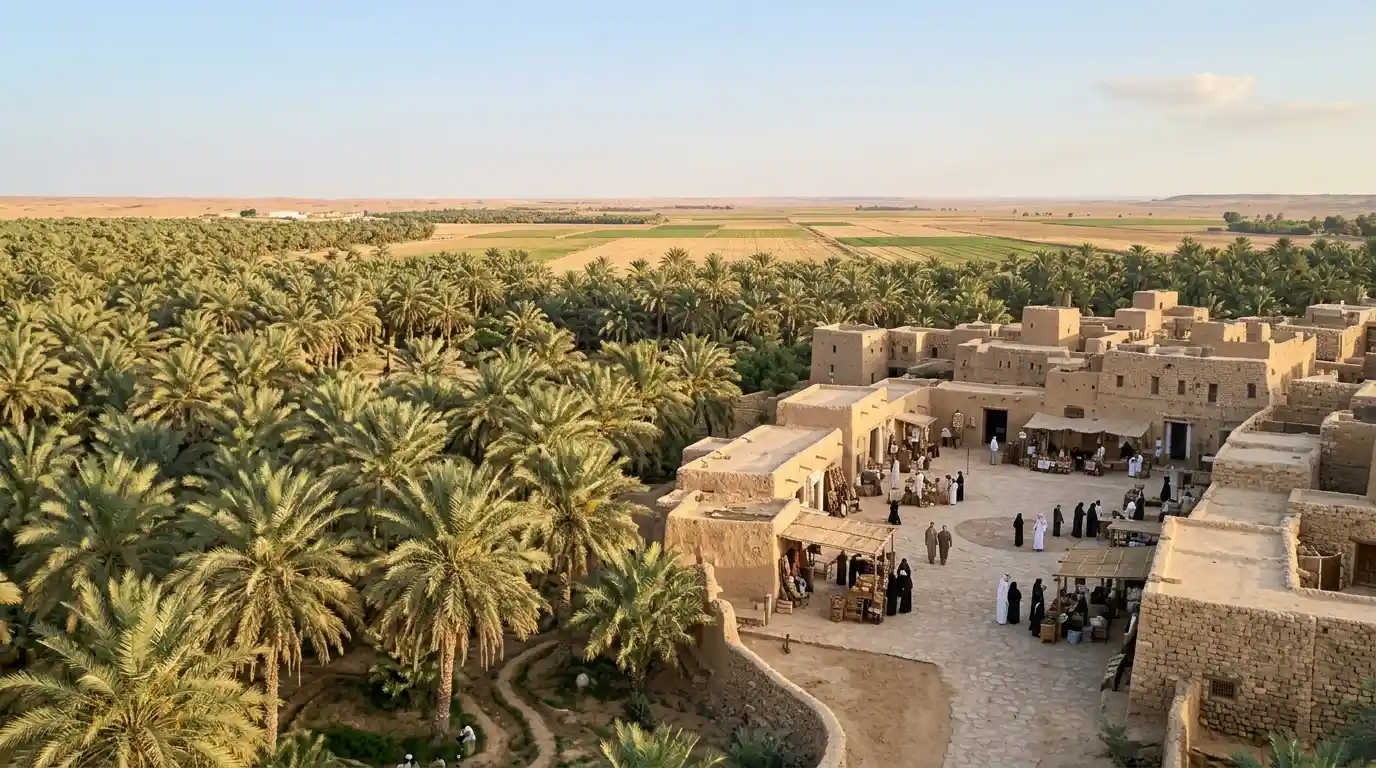
Best Time to Visit Al Qassim: Weather, Crowds & Experiences
The best time to visit Al Qassim for most travelers is from November through March. This is the most comfortable period for exploring traditional markets, heritage villages, date farms, desert landscapes, parks, rural attractions, and the region’s widely dispersed towns without having to organize every outdoor activity around intense heat. Visit Saudi’s current Qassim itinerary guidance specifically recommends November through March, while its destination climate information places typical winter conditions around 9–22°C compared with summer conditions around 24–40°C.
There is one important exception. Travelers whose main reason for visiting is the region’s famous date harvest and major date carnivals may prefer late summer into early autumn, even though the weather is considerably hotter. Current official tourism information shows Buraidah’s large date market running across the late-summer and early-autumn period, with major carnival activities in Buraidah and Unaizah concentrated within that broader harvest season.
The best time to visit Al Qassim therefore depends on whether weather comfort or seasonal agriculture matters more. Choose winter for the easiest all-round heritage, desert, outdoor, and road-trip experience. Choose the date season if markets, harvest activity, farm culture, and regional food are the central purpose of your trip. Spring can be excellent for desert scenery after rainfall, while summer is workable for travelers willing to shift outdoor sightseeing toward mornings and evenings.
For a broad introduction to the province, start with the Al Qassim travel guide. Once you know your dates, use the Al Qassim itinerary to organize Buraidah, Unaizah, heritage towns, farms, and wider road excursions geographically.
Best Time to Visit Al Qassim at a Glance
| Season | Typical destination temperature range | Best suited to | Main advantage | Main tradeoff |
|---|---|---|---|---|
| Winter | About 9–22°C | Heritage, desert trips, markets, families, road travel | Best overall outdoor comfort | Cold mornings and evenings |
| Spring | About 19–34°C | Photography, nature, desert parks, heritage | Mild-to-warm conditions and possible post-rain greenery | Heat increases through the season |
| Summer | About 24–40°C | Date season, indoor attractions, evening activities | Major agricultural activity | Strong daytime heat |
| Autumn | About 15–30°C | Date markets, mixed sightseeing, road trips | Harvest atmosphere with improving weather | Early autumn can remain hot |
These are broad seasonal ranges from Visit Saudi rather than daily forecasts. Al Qassim has a desert continental climate, and the National Center for Meteorology describes the region as hot in summer, cold in winter, and generally low in rainfall.
For detailed climate reference rather than a travel recommendation, use Al Qassim weather by month.
Why November Through March Is Best for Most Travelers
November through March is the best time to visit Al Qassim when your trip combines several types of experiences. Traditional villages require walking through exposed streets and courtyards. Markets often involve time moving between stalls. Desert and agricultural excursions can keep you outdoors for hours. Road trips between Buraidah, Unaizah, Al Mithnab, Uyun Al Jiwa, and other towns also become more enjoyable when you can stop spontaneously without immediately needing air conditioning.
Visit Saudi currently states directly that Qassim is best enjoyed between November and March. Recent Saudi Press Agency reporting also describes a noticeable winter tourism surge built around heritage villages, traditional markets, desert adventures, rural tourism, farms, and Najdi hospitality.
That combination makes winter the best time to visit Al Qassim for a first trip. You do not need to choose between cultural sightseeing and outdoor travel because both become practical within the same journey.
Travelers deciding which attractions deserve the most time can use things to do in Al Qassim before building the final schedule.
Winter: Best Overall for Heritage and Outdoor Exploration
Winter provides the broadest margin for comfortable sightseeing. Visit Saudi’s current seasonal figures place winter temperatures around 9–22°C, although individual days can fall outside that range.
Those conditions are particularly useful in Al Qassim because the province’s strongest heritage environments are not concentrated inside climate-controlled buildings. Traditional streets, old markets, mud-brick villages, date farms, rural landscapes, and desert attractions require substantial outdoor time.
A winter visit lets you explore the old architecture of Al Mithnab or walk around Unaizah without treating shade as the most important itinerary factor. It also makes it easier to combine an outdoor heritage stop with a farm experience or desert excursion rather than retreating indoors for most of the afternoon.
For travelers primarily interested in the past, historical places in Al Qassim and culture and heritage in Al Qassim provide the specialist detail.
Winter Is Also a Major Tourism Season
Cooler weather does not necessarily mean empty attractions. Recent official reporting describes winter as a strong tourism period across Qassim, with visitors drawn to traditional markets, heritage villages, rural tourism, farms, desert activities, horseback riding, off-road recreation, and organized camps.
The best time to visit Al Qassim for good weather can therefore overlap with stronger domestic visitor demand, particularly on weekends or around popular seasonal attractions.
Crowds in Qassim are generally distributed rather than concentrated in a single attraction. Higher demand may appear as fuller farm experiences, busier cafés, more activity at heritage markets, increased traffic around recreational areas, or greater accommodation demand rather than the shoulder-to-shoulder sightseeing associated with some global tourism cities.
Travelers who value flexibility should book important accommodation or organized experiences earlier, especially during popular weekends.
Winter Is Excellent for Desert Experiences
The best time to visit Al Qassim for desert recreation is usually during the cooler part of the year. Current SPA reporting describes winter tourism in the region as including Nafud desert experiences, off-road cycling, horseback riding, and family camping.
Cooler daytime temperatures make longer periods outside more practical, while nights can become substantially colder. A sunny afternoon should not be used as an indication of how warm a desert campsite will remain after sunset.
Travelers wanting an organized excursion should consult desert safari in Al Qassim. Anyone planning an overnight stay should use camping in Al Qassim before treating a desert camp as a casual extension of an ordinary sightseeing day.
Rain Can Transform the Landscape
Al Qassim is generally dry, but cooler-season rainfall can temporarily change the desert environment. Recent official reporting documented increased visitor activity at Qassim’s desert parks after rainfall brought milder conditions and fresh greenery, attracting families to picnics and nature outings.
This means the best time to visit Al Qassim for green desert scenery cannot be guaranteed months in advance. Vegetation and temporary landscape changes depend on actual rainfall rather than a fixed tourism calendar.
Photographers and nature-oriented visitors may find post-rain periods particularly rewarding, but weather safety comes first. Do not drive onto flooded or unsuitable tracks simply because a greener landscape appears attractive online.
For photography-focused planning, continue to Al Qassim photography spots.
Al Ghadha Park Is Especially Appealing in the Cooler Season
Unaizah’s Al Ghadha Park provides a good example of why season matters. Recent official reporting describes the large protected saxaul landscape as a destination for families, camping, nature, and recreation, with particularly strong relevance during winter and rainy periods.
Travelers who want to combine Unaizah’s heritage and cafés with a more nature-oriented experience may therefore find winter especially useful. You can explore an urban market and then spend time in an open desert environment without the strong heat that dominates summer afternoons.
This type of mixed trip is one reason November through March remains the best time to visit Al Qassim for general travelers rather than only heritage enthusiasts.
Spring: A Good Shoulder Season
Spring can be one of the strongest alternatives to winter. Visit Saudi currently places predicted spring conditions around 19–34°C, meaning temperatures are warmer but can remain suitable for heritage sightseeing and road travel, particularly earlier in the season.
The best time to visit Al Qassim in spring depends on what you plan to do. A traveler moving mainly between Buraidah, Unaizah, cafés, restaurants, museums, and markets has considerably more tolerance for warmer conditions than someone planning long desert hikes or exposed village walks.
Spring also has a nature advantage. Rain can refresh desert parks and open landscapes, while recent reporting describes Mount Tamya as attracting more visitors during spring for camping, hiking, desert excursions, and nature photography.
The tradeoff is that temperatures rise as the season progresses. Travelers sensitive to heat should generally favor the earlier part of spring.
Spring Is Strong for Photography and Road Trips
Longer daylight and generally manageable conditions make spring attractive to photographers and self-drive visitors. Mud-brick architecture, palm groves, farm landscapes, desert roads, and heritage towns can be explored without the coldest winter mornings.
Road travelers also gain flexibility because the region’s main attractions are spread across multiple towns. A spring trip can combine Buraidah and Unaizah with selected heritage excursions without forcing every outdoor stop into a narrow temperature window.
Travelers planning to self-drive can use driving in Al Qassim for the road-specific considerations, while getting around Al Qassim compares cars with other transport choices.
Summer: Hot, but Important for Date Culture
Summer is not the best time to visit Al Qassim for general outdoor sightseeing. Visit Saudi’s current destination guidance shows predicted summer temperatures around 24–40°C, while NCM characterizes Qassim’s climate as hot in summer.
That level of heat makes long midday walks through heritage villages, exposed markets, desert attractions, or archaeological landscapes less comfortable. Summer travelers should structure the day differently: earlier outdoor activity, midday indoor time, and a return to parks, cafés, markets, or public spaces later.
However, summer has one major reason to visit: dates.
The region’s date palms begin moving into their annual ripening and harvest cycle during the warmer season, creating one of Al Qassim’s most culturally distinctive travel experiences. SPA reporting notes that the rutab stage signals the approaching harvest and draws activity toward farms and markets.
For some travelers, that makes summer or early autumn the best time to visit Al Qassim despite the heat.
The Buraidah Date Carnival Changes the Seasonal Equation
Buraidah’s date carnival is one of the most important agricultural events in the region. Current official tourism listings place the wider market season from early August into mid-October, with major cultural and entertainment programming concentrated within part of that period.
The event includes large-scale date trading as well as cultural, food, agricultural, and tourism programming. Current SPA reporting describes daily auctions, premium-date displays, cooking activities, heritage exhibitions, crafts, family programming, museum elements, and tourism excursions linked to farms and other regional sites.
For a visitor who wants to understand Qassim’s relationship with palm cultivation rather than simply see a historical village, this can be one of the most meaningful periods of the year.
The tradeoff is obvious: you are choosing agricultural seasonality over maximum weather comfort.
Unaizah Has Its Own Date-Season Experience
Unaizah also hosts a major dates carnival during the same broad late-summer period. Current Visit Saudi information places its main carnival from the second half of August into September.
This means date-season travelers should not automatically remain in Buraidah for the entire agricultural experience. Unaizah can offer its own combination of dates, heritage, cafés, traditional markets, and parks.
The best time to visit Al Qassim for serious food or agricultural interest may therefore fall during the date season rather than winter, provided you are comfortable changing the day’s rhythm around the heat.
For broader culinary planning, use food in Al Qassim and best restaurants in Al Qassim.
Should You Visit During the Date Harvest?
Choose the date season when the agricultural experience is genuinely important to you. Do not select it simply because a festival appears on a calendar if your real priority is hiking, heritage walking, or desert camping.
A date-season trip works especially well for travelers interested in markets, food, photography, farms, cultural programs, local commerce, and the relationship between agriculture and Qassim identity.
A winter trip works better when you want outdoor comfort, heritage villages, road travel, desert excursions, family parks, camping, and long days outside.
Neither period is universally superior. The best time to visit Al Qassim is the season that best matches the experience you actually want.
Autumn: Harvest Energy Meets Improving Weather
Autumn offers an interesting transition. Visit Saudi’s broad seasonal figures place autumn around 15–30°C, although early autumn can remain warmer before conditions progressively improve.
The early part of autumn can still overlap with major date-market activity, creating a useful compromise between agricultural interest and gradually improving weather.
Later in autumn, the best time to visit Al Qassim begins shifting toward the cooler-season model. Long heritage walks, rural attractions, desert trips, and outdoor cafés become increasingly comfortable.
Travelers with flexible dates who want some connection to the date season without choosing the hottest period may find autumn particularly attractive.
Best Time to Visit Al Qassim for Heritage
November through March is generally the best time to visit Al Qassim for traditional architecture, historic villages, and heritage markets.
Al Mithnab, Uyun Al Jiwa, Al Khabra, and heritage areas around Unaizah all involve outdoor or semi-outdoor exploration. Cooler conditions make it much easier to slow down, photograph architectural details, walk between buildings, and understand the settlement rather than rushing from shade to shade.
Winter tourism programming also actively emphasizes Qassim’s heritage villages and traditional markets.
Travelers building their trip around this theme should continue to heritage walk in Al Qassim after deciding which town deserves the most walking time.
Best Time for Buraidah
The best time to visit Al Qassim with Buraidah as your primary focus depends heavily on whether you want its general city experience or date-season atmosphere.
For museums, restaurants, parks, heritage, rural tourism, and broader sightseeing, winter provides the easiest conditions.
For date trading and the major carnival, late summer into early autumn is the defining period. Current official data shows substantial commercial activity and high visitor flows during the date season, including buyers and visitors from Saudi Arabia, Gulf countries, and elsewhere.
Travelers choosing that period should reserve more time around market-related experiences and expect the date economy to shape the city’s atmosphere.
Best Time for Unaizah
Winter is excellent for combining Unaizah’s traditional market, cafés, parks, heritage spaces, and Al Ghadha’s desert environment. Current official reporting specifically identifies Al Ghadha as a winter and rainy-season retreat for families, campers, and outdoor enthusiasts.
Late summer is better if the Unaizah International Dates Carnival is the main draw.
Couples or travelers interested in cafés and relaxed heritage exploration may prefer winter or early spring, while food-focused travelers may deliberately accept warmer conditions to experience the date season.
Best Time for Families
For most families, winter is the best time to visit Al Qassim. Children can spend longer at outdoor markets, farms, parks, and heritage villages without the same heat burden as summer.
Recent winter tourism activity in the region includes family camps, farms, traditional markets, heritage destinations, and outdoor recreation, supporting a broader mix of experiences than a purely urban trip.
Spring can also work well, particularly for families who prefer warmer daytime conditions. Summer remains possible, but midday outdoor activity should be reduced and evening plans become more important.
For age-specific activities and pacing, use Al Qassim with kids.
Best Time for Older Travelers and Limited Mobility
Cooler weather can make a significant difference for travelers with limited mobility because heritage environments may already involve uneven ground, thresholds, longer walks, and moving between parking areas and historic buildings.
Winter daytime conditions generally provide the widest margin for comfort. Travelers who strongly dislike cold mornings can shift outdoor activity later in the day or choose the shoulder periods.
Accommodation location also matters. Staying close to the attractions that matter most can reduce repeated vehicle transfers and walking. Use where to stay in Al Qassim to compare bases before choosing dates solely by temperature.
Best Time for Camping
Winter is usually the strongest season for camping because the daytime heat becomes manageable and the wider tourism season supports desert recreation and family camps.
The main risk is underestimating overnight cold. Bring equipment appropriate to the actual forecast rather than assuming clear daytime skies mean warm nights.
Rain can also alter desert access. A landscape that becomes greener after rainfall may attract more visitors but can require additional caution on unpaved surfaces.
The best time to visit Al Qassim for camping is therefore a cool, stable-weather period rather than simply the coldest available night.
Best Time for Stargazing
Cool-season evenings can provide attractive conditions for stargazing because travelers can combine daytime heritage with nighttime desert activity. However, winter cold, cloud, dust, moon phase, and safe access all affect the experience.
Autumn and spring may provide a more comfortable compromise for people who dislike cold nights but still want to escape the strongest summer heat.
Use stargazing in Al Qassim for specialist dark-sky planning rather than choosing a season from air temperature alone.
Best Time for Cafés, Markets, and Food
Food-focused travel can work throughout the year because restaurants, cafés, and much of the commercial environment are not as weather-dependent as desert excursions.
Winter provides the easiest balance if you want to move between indoor food experiences and outdoor markets. Summer and early autumn become particularly interesting when the date harvest shapes local commerce.
Visitors interested in contemporary café culture can use best cafes in Al Qassim, while those who want local specialties should prioritize the food guide.
The best time to visit Al Qassim for a culinary trip may therefore depend more on whether you want dates in season than on the lowest temperature.
Best Time for Museums
Museums are a year-round option and become especially useful at the climatic extremes. In summer, they can occupy the strongest midday heat. In winter, they provide an indoor alternative during colder mornings or occasional unsettled weather.
Travelers interested in indoor cultural context can use museums in Al Qassim.
A museum-heavy itinerary does not need to be scheduled only in winter, which gives travelers with fixed dates more flexibility.
When Are Crowds Highest?
There is no single permanent crowd season across the whole region.
Winter can draw substantial tourism because of comfortable weather, heritage programming, desert adventures, farms, and rural experiences.
Late summer and early autumn bring another type of demand around Buraidah and Unaizah because of the date markets and carnivals. Current official reporting describes increasing numbers of shoppers and visitors during the Buraidah date season.
Weekends, school breaks, and major events can increase demand further. Travelers seeking maximum quiet should therefore look beyond temperature and check what is happening during their exact stay.
Best Time for Lower Crowds
If avoiding event-related demand is more important than experiencing the date carnival or winter programming, choose dates outside major festival periods and consider weekdays.
Late autumn or early spring can provide a useful balance: generally workable temperatures without deliberately targeting the busiest agricultural or winter-event periods.
That does not guarantee empty attractions, but it reduces the likelihood that your trip overlaps the region’s most obvious seasonal draws.
Budget travelers may also appreciate greater accommodation flexibility outside peak event periods. The Al Qassim on a budget guide covers those tradeoffs more directly.
Best Time for Solo Travel
Solo travelers have more freedom to adapt each day to weather. A clear winter morning can become a heritage excursion; a rainy period can be moved toward cafés or museums; a date-season visit can linger at markets without negotiating a group schedule.
Winter is generally the easiest all-round season, but solo travelers particularly interested in photography or agriculture may prefer spring or date season.
Transport is a greater concern than season once you leave Buraidah and Unaizah. Use solo travel in Al Qassim for independent transport and regional-planning considerations.
Best Time for Photography
Winter provides comfortable outdoor working conditions and softer daylight for traditional architecture, desert landscapes, farms, and markets. Spring may bring more varied skies and greener post-rain scenery. Date season adds unusually strong agricultural and market imagery, but with hotter conditions.
The best time to visit Al Qassim for photography therefore depends on the subject.
Choose winter for heritage and desert work.
Choose spring for landscape variety.
Choose the date season for agriculture, market activity, food culture, and palm harvest imagery.
Photographers should avoid disrupting vendors or agricultural work simply to create a scene.
Does Rain Make Spring Better?
Rain can enhance Qassim visually, but it should be treated as an unpredictable bonus rather than a reason to book one exact week. Official reporting shows that desert parks become particularly attractive after rainfall because cooler conditions and vegetation draw families and nature visitors.
Rain can also affect unpaved access. Check current weather and local conditions before driving toward desert parks, camps, or isolated landscapes.
This is one reason the best time to visit Al Qassim should be expressed as a broad season rather than a promise about one month.
What If You Can Only Visit in Summer?
A summer trip can still work if you accept that the itinerary must change.
Use early morning for heritage villages or outdoor attractions. Spend midday in museums, restaurants, cafés, accommodation, or air-conditioned commercial spaces. Return outside later for parks, markets, dining, and social activity.
If you are visiting during date season, make the agricultural experience the strength of the trip rather than treating the heat as a failure to reproduce a winter itinerary.
Use free things to do in Al Qassim to find additional low-cost options that can fit around your climate-adapted schedule.
What If You Can Only Visit in Winter?
Winter is generally the easiest fixed-date scenario. Bring layers for mornings and evenings and use the mildest parts of the day for walking-heavy heritage attractions.
If camping or stargazing is part of the plan, pack according to nighttime temperatures rather than afternoon conditions.
Winter is also an excellent period to explore farm-based heritage and rural tourism. Current SPA reporting describes regional farms offering experiences connected with harvesting, bread making, and Najdi hospitality during the winter tourism season.
Are Qassim’s Heritage Attractions Seasonal?
The core heritage is not seasonal. Traditional houses, markets, villages, museums, and restored rural destinations increasingly operate as year-round visitor experiences. Recent official reporting describes heritage houses and farms being developed into year-round tourism venues.
Season changes how comfortable and active those experiences feel rather than determining whether Qassim’s culture exists.
Winter supports the easiest outdoor exploration. Date season adds agricultural energy. Summer favors shorter outdoor visits and more evening activity.
This distinction is important when choosing the best time to visit Al Qassim: weather changes the travel style, not the destination’s fundamental identity.
Should Festivals Determine Your Dates?
Only when the festival itself matters to you.
Current official listings show major date events running through late summer and early autumn, while winter has its own heritage, farm, and desert programming.
Event schedules can change, so verify the current Saudi tourism calendar close to booking. Do not assume a festival repeats on identical dates every season.
Travelers more interested in quiet streets, architecture, and regional food may be happier outside a major event period.
Match the Season to Your Travel Style
For a first visit, November through March is the best time to visit Al Qassim.
For heritage villages and traditional markets, choose winter.
For desert safaris and camping, choose the cooler season and check current weather.
For spring landscapes, photography, and desert parks after rain, consider March or the milder part of spring.
For dates, agricultural commerce, and the Buraidah or Unaizah carnivals, choose late summer into early autumn and prepare for heat.
For families, winter and the milder shoulder periods are generally easiest.
For couples and slower road trips, winter or early spring provides a comfortable balance.
For budget-conscious travelers, compare event demand and accommodation rather than assuming the hottest season will automatically be cheapest.
For travelers still questioning whether the region suits their interests, is Al Qassim worth visiting provides a more direct decision guide.
The Practical Recommendation
The best time to visit Al Qassim for most travelers is November through March. Visit Saudi currently recommends that window, and the region’s winter temperature profile is much better suited to heritage villages, traditional markets, desert excursions, parks, rural tourism, and long road trips than the hottest part of the year.
Choose late summer into early autumn instead when date culture is the main reason for your visit. Buraidah and Unaizah host major seasonal date activity, giving travelers access to a side of Qassim that is impossible to reproduce fully during winter.
Choose spring when you want warmer conditions, photography, desert scenery, and the possibility of greener landscapes after rain without moving directly into peak summer heat.
Whatever period you choose, remember that Al Qassim is geographically spread out. Weather comfort matters partly because much of the experience involves driving and outdoor stops across several towns. Once your dates are fixed, use getting around Al Qassim and the main itinerary to build a route that matches the season.
For wider country planning, continue with the Saudi Arabia travel guide.
Frequently Asked Questions
What is the best time to visit Al Qassim overall?
The best time to visit Al Qassim for most travelers is November through March. Visit Saudi currently recommends this period, and winter temperatures are much more comfortable for heritage villages, traditional markets, road trips, farms, desert excursions, and outdoor sightseeing.
What is the best time to visit Al Qassim for the date harvest?
Late summer into early autumn is the most important period for date-market activity. Current official listings place Buraidah’s wider date carnival across August into October, while Unaizah’s major date carnival operates during part of August and September. Exact future dates should always be verified.
Is winter cold in Al Qassim?
Yes, particularly compared with what many visitors expect from Saudi Arabia. Visit Saudi currently shows predicted winter conditions around 9–22°C, and mornings and evenings can feel considerably cooler than daytime.
Is summer too hot to visit Al Qassim?
Summer is less comfortable for long outdoor sightseeing, with Visit Saudi showing predicted seasonal temperatures around 24–40°C. It remains worthwhile for travelers interested in date culture, provided outdoor visits are shifted toward cooler hours.
When is the best time for desert camping in Al Qassim?
The cooler season is generally best. Current official reporting highlights winter desert activities and family camping as important parts of Qassim’s seasonal tourism. Nights can become cold, so camping equipment should match the actual forecast.
Does Al Qassim get green after rain?
Parts of the desert landscape can become noticeably greener after rainfall. Recent official reporting describes Qassim’s desert parks attracting increased visitor numbers following rain because of cooler weather and fresh vegetation.
When are crowds highest in Al Qassim?
Demand can increase during winter tourism periods and around major date carnivals in late summer and early autumn. Current official reporting shows significant visitor activity during both winter heritage tourism and the Buraidah date season.
Is spring a good time to visit Al Qassim?
Yes. Spring can provide comfortable-to-warm conditions for road trips, heritage, photography, and desert landscapes. Visit Saudi shows predicted spring temperatures around 19–34°C, while some natural areas receive increased visitor activity during spring.