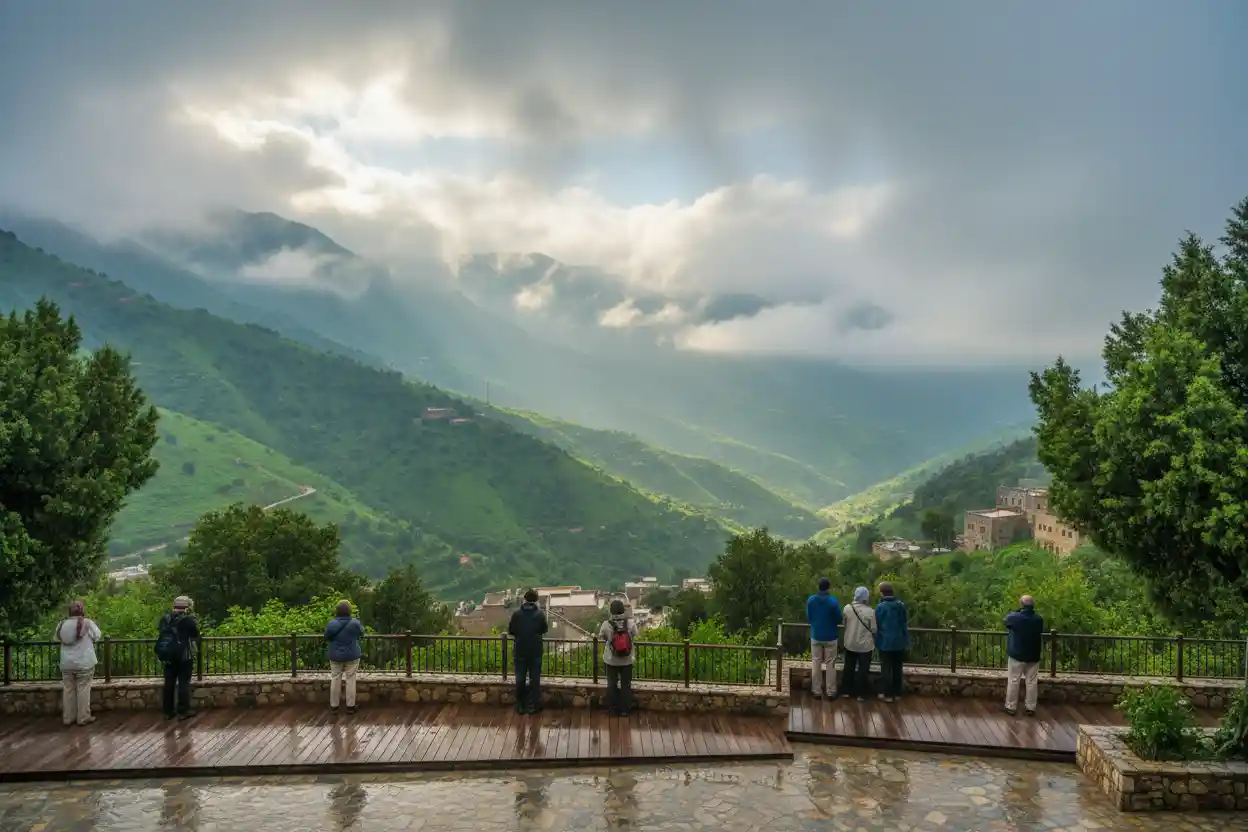
Abha Weather by Month: Temperatures and Seasonal Conditions
Abha weather by month is considerably milder than many travelers expect from Saudi Arabia because the city sits high in the Sarawat Mountains of Aseer. Typical daytime highs move from roughly 17–19°C during the coolest part of the year to around 28°C during the warmest months, while average nighttime lows generally range from about 8°C in the coolest months to around 17°C in summer. Rain, cloud and fog can occur in several seasons, and the southwestern highlands are unusual within Saudi Arabia because they can receive rainfall during summer as well as during cooler parts of the year.
That combination gives Abha a climate very different from the extreme summer heat associated with lower-elevation parts of the Kingdom. Saudipedia describes Abha as having moderate summers and cooler winters and notes that its highland position contributes to comparatively high rainfall. The National Center for Meteorology similarly identifies Aseer as a major exception to Saudi Arabia’s predominantly dry climate and explains that southwestern regions can receive summer rainfall through seasonal circulation interacting with mountain topography.
For travelers, monthly averages are most useful for packing and understanding broad seasonal conditions. They are not a guarantee of what any particular day will feel like. Elevation, cloud, rain, wind and the difference between central Abha and higher mountain areas can create noticeably different conditions within the same trip. Check the current forecast shortly before outdoor excursions, particularly if your itinerary includes Al Soudah, hiking or mountain driving.
For the actual decision about when to travel, use best time to visit Abha. This page stays focused on month-by-month climate and seasonal conditions rather than duplicating that recommendation intent.
Abha Weather by Month at a Glance
| Month | Typical daytime high | Typical nighttime low | General conditions |
|---|---|---|---|
| January | ~17°C | ~8°C | Cool days, chilly nights, layers useful |
| February | ~19°C | ~9°C | Cool to mild, comfortable daytime sightseeing |
| March | ~21°C | ~11°C | Mild spring conditions, increasing shower potential |
| April | ~23°C | ~13°C | Pleasant temperatures with greater rain variability |
| May | ~26°C | ~15°C | Warmer days, mild evenings, unsettled weather possible |
| June | ~28°C | ~17°C | Warm but moderate for Saudi Arabia, summer rain possible |
| July | ~28°C | ~17°C | Mild highland summer, cloud, mist and showers possible |
| August | ~28°C | ~17°C | Warm highland conditions with seasonal rain potential |
| September | ~27°C | ~15°C | Warm days, cooler evenings, gradual transition |
| October | ~24°C | ~12°C | Comfortable days and increasingly cool evenings |
| November | ~21°C | ~9°C | Mild afternoons, noticeably cooler mornings and nights |
| December | ~18°C | ~8°C | Cool highland weather and cold-feeling evenings |
The temperature figures above are rounded long-term planning averages for Abha rather than forecasts. WeatherSpark’s Abha climate profile shows the same broad annual pattern, with average highs rising from the upper teens Celsius in the coolest period to around the upper twenties in summer. Saudi official sources independently support the broader picture of a cool winter and moderate summer climate.
January Weather in Abha
January is one of Abha’s coolest months. Typical daytime temperatures reach around 17°C, while nighttime lows can fall to about 8°C. Those numbers may sound mild to travelers from colder climates, but the combination of mountain elevation, wind and evening exposure can make the air feel considerably cooler than the temperature alone suggests.
Daytime sightseeing can be comfortable with light layers, particularly when the sun is out. Once evening arrives, a jacket becomes much more useful. Travelers planning elevated viewpoints or outdoor dinners should carry an extra layer rather than assuming clothing suitable for midday will remain comfortable after sunset.
Rain and cloud remain possible. Abha is not a destination where a cool month automatically means dry blue skies every day, and the highlands can receive precipitation outside the summer season. Winter humidity can also be higher than in summer according to Saudipedia’s long-term description of the city’s climate.
January works particularly well for urban culture, markets and walking when conditions are dry, but hikers should pay more attention to cold-feeling mountain conditions at elevation.
February Weather in Abha
February begins the gradual transition toward milder weather. Average daytime highs rise to roughly 19°C, while nighttime lows remain around 9°C. Days can feel pleasantly cool to mild, especially for travelers who prefer sightseeing without stronger summer warmth.
The main packing strategy remains layering. A light top may be enough during a sunny afternoon, but mornings, evenings and higher mountain locations can require warmer clothing. Travelers who spend most of the day moving between indoor attractions and central Abha may experience relatively easy conditions, while anyone heading into exposed highlands should prepare for greater variation.
Cloud and occasional rain can still interrupt outdoor plans. Keep footwear practical if the itinerary includes heritage areas, parks or walking paths where surfaces may become damp.
February is a transitional month rather than a dramatic seasonal change, so the short-range forecast matters more than assuming the whole month behaves one particular way.
March Weather in Abha
March brings noticeably milder conditions, with typical highs around 21°C and lows near 11°C. For many travelers, this is an easy temperature range for walking, cultural sightseeing and spending extended periods outdoors.
Rain becomes a more important planning factor as spring develops. WeatherSpark’s long-term profile shows an increase in rainy-day frequency moving into spring, while official Saudi climate information notes that rainfall across much of the Kingdom becomes more significant during winter and spring.
That does not mean March should be considered continuously wet. The practical implication is simply that travelers should keep a flexible outdoor schedule. A mountain morning may be excellent while an afternoon shower encourages a shift toward museums, restaurants or other covered activities.
Greenery can become particularly attractive after rain, making the weather itself part of the destination experience.
April Weather in Abha
April is mild, with average daytime highs around 23°C and nighttime lows near 13°C. This creates comfortable temperatures for many forms of sightseeing, but precipitation variability becomes one of the month’s more important characteristics.
WeatherSpark identifies April as the wettest month in its long-term Abha rainfall profile, while Saudi climate sources also characterize spring as an important rainfall period. The exact amount varies considerably between years and locations, especially across mountainous terrain.
Travelers should therefore avoid designing an April itinerary in which every important experience requires completely dry weather. Outdoor sightseeing can still be excellent, but having one or two indoor alternatives makes the trip more resilient.
Rain can also affect mountain roads and trail surfaces. A route that is straightforward when dry may become slippery or slower after a shower, so hiking plans should respond to actual conditions rather than monthly averages.
For a broader sightseeing framework, the Abha itinerary can help balance indoor and outdoor activities.
May Weather in Abha
May marks a clearer move into warmer conditions. Average daytime highs reach approximately 26°C, with nighttime temperatures around 15°C. The days feel warmer without reaching the extreme summer temperatures common in many lower-elevation Saudi cities.
Outdoor activity can remain comfortable, particularly in the morning and later afternoon. Midday sun deserves greater attention, however, especially during open walks where shade is limited. Sun protection and water become increasingly important even though the air may feel pleasant compared with hotter parts of Saudi Arabia.
Rain can still occur, and the transition toward the southwestern summer-rain regime means visitors should not assume the arrival of warmer temperatures signals the beginning of a completely dry season. The National Center for Meteorology explains that southwestern Saudi Arabia can receive rainfall during summer because of seasonal atmospheric circulation interacting with the region’s topography.
May is therefore best understood as warm highland weather with meaningful day-to-day variability.
June Weather in Abha
June is among Abha’s warmest months, but “warm” here remains relative. Average daytime highs sit around 28°C and nighttime lows around 17°C, which is one reason Abha attracts visitors seeking an escape from more intense heat elsewhere in Saudi Arabia.
The temperature difference between Abha and much of the wider Kingdom becomes particularly noticeable during summer. Official Saudi climate information emphasizes that the southwestern mountains moderate summer conditions, while Saudipedia similarly characterizes Abha’s summer climate as comparatively mild.
Rain and cloud remain possible. Southwestern Saudi Arabia has a distinct summer-rain component, so an afternoon shower should not be treated as unusual simply because June falls within summer. Mountain cloud may also change visibility at viewpoints.
Travelers should still use sun protection and stay hydrated. Mild temperatures do not remove the effects of elevation, direct sunlight or several hours of walking outdoors.
July Weather in Abha
July typically remains around 28°C during the day, with nighttime lows near 17°C. Temperatures are therefore broadly similar to June, but the lived experience of the weather can change significantly depending on cloud cover, mist, rain and elevation.
Summer rainfall is an important part of the wider Aseer climate pattern. Saudipedia describes Abha as one of Saudi Arabia’s cities with the highest summer rainfall rates, while the National Center for Meteorology explains the atmospheric mechanism behind summer rainfall in the southwest.
For travelers, this can produce beautiful green mountain conditions but also more uncertainty around panoramic views. A cloudy afternoon at Al Soudah may provide atmospheric mist while limiting long-distance photography.
July is also associated with a popular visitor period in the Aseer highlands because travelers seek relief from hotter conditions elsewhere. That can translate into more activity around parks, restaurants and major attractions, although exact crowd levels depend on holidays and events rather than the month alone.
August Weather in Abha
August remains warm but moderate, with typical Abha highs around 28°C and lows near 17°C. It is another core highland-summer month, with the city’s elevation preventing the extreme daytime temperatures associated with many other Saudi destinations.
Aseer can experience frequent rainfall and rainstorms in higher terrain, and Saudipedia describes the province’s summer climate as mild by Saudi standards. Summer cloud and mist can therefore remain part of the travel experience rather than an exception.
Travelers visiting primarily for viewpoints should build flexibility into each day. A mountain panorama may be clear during one part of the day and obscured later. If visibility is poor, use cultural or indoor sightseeing and return to scenic areas when conditions improve.
August can also feel busier during popular regional travel periods. Reserve accommodation and major experiences early when demand appears strong, but do not assume every part of the city will be crowded continuously.
September Weather in Abha
September begins the gradual transition away from peak summer warmth. Typical daytime highs are around 27°C and nighttime lows around 15°C, creating warm days and increasingly comfortable evenings.
The temperature change is modest rather than abrupt. Visitors can still plan significant outdoor time, but early mornings and evenings may feel noticeably fresher than midday. A light layer can become useful again, particularly at elevation.
WeatherSpark’s long-term rainfall profile shows less precipitation around this point than during its wetter spring period, although the broader southwestern climate remains capable of producing showers and variable mountain weather.
September can be particularly pleasant for travelers who enjoy walking and nature but do not need the coolest conditions of winter.
October Weather in Abha
October brings a clearer cooling trend. Average daytime highs are about 24°C, while nighttime lows move toward 12°C. Those conditions are comfortable for sightseeing, with warm-to-mild afternoons and cooler mornings and evenings.
Outdoor travelers may find the temperature range particularly manageable because prolonged walking becomes easier than during warmer months. Mountain evenings can still feel significantly cooler than central-city afternoons, so carrying an adaptable layer is sensible.
Rain remains possible, but the month’s day-to-day experience can vary considerably. Some periods may feel bright and dry while others bring cloud or showers.
October is also a good example of why Abha weather by month should be used as context rather than as a fixed itinerary. The average temperature provides packing guidance; the actual forecast decides whether your day should prioritize hiking, viewpoints or sheltered attractions.
November Weather in Abha
November feels distinctly cooler, with typical highs around 21°C and nighttime lows around 9°C. Daytime conditions can remain very comfortable, but evening temperatures make warmer layers increasingly important.
Early-morning departures for mountain trips can feel particularly cool. Travelers who leave a warm hotel expecting afternoon conditions may find themselves underdressed during the first part of the day.
The cooling weather can suit cultural sightseeing, markets and longer walks well when rain is absent. Those heading into higher mountain areas should expect conditions to be cooler than the central Abha averages suggest.
This is also a month when travelers should start packing with winter-style evening comfort in mind rather than focusing exclusively on Saudi Arabia’s generally warm reputation.
December Weather in Abha
December is one of the coolest months in Abha. Typical daytime highs average around 18°C, with lows near 8°C. Higher terrain can be colder, and wind can make exposed viewpoints feel noticeably more wintry.
Saudipedia describes Abha’s winter climate as cool and notes that high mountain environments in the wider area can experience much lower temperatures than central-city conditions.
For travelers, this means genuine layers rather than carrying a jacket purely as a precaution. Evening restaurant terraces, viewpoints and pre-sunrise departures can all feel cold enough that lightweight summer clothing alone is uncomfortable.
December does not eliminate outdoor sightseeing. Clear cool days can be excellent for walking, but the shorter-feeling daylight period and cold evenings reward earlier starts and a more deliberate schedule.
Abha Temperatures Through the Seasons
The monthly pattern can be simplified into four broad temperature phases.
December through February are the coolest months, when days remain mild by cold-climate standards but nights often require a jacket. March through May bring steadily warmer spring conditions, with comfortable daytime temperatures and greater attention to showers. June through September form Abha’s warm highland period, with average highs around the upper twenties rather than extreme desert heat. October and November provide a gradual transition back toward cooler evenings.
Official Saudi sources describe essentially the same broader seasonal pattern: Abha and Aseer are cooler than many other parts of the Kingdom in winter and notably milder during summer because of elevation.
The distinction matters when packing. Abha is not a destination where one lightweight summer wardrobe automatically works across the year.
How Rainfall in Abha Differs From Much of Saudi Arabia
Rain is one of the most important differences between Abha and the stereotypical image of Saudi weather. The National Center for Meteorology identifies Aseer as an exception to the country’s predominantly dry climate, with the southwestern region receiving significantly more precipitation than many other parts of the Kingdom.
The timing is also unusual. Winter and spring weather systems contribute precipitation, while the southwest can receive summer rainfall through seasonal atmospheric circulation interacting with mountain topography. Saudipedia specifically identifies Abha among the Saudi cities with the greatest summer rainfall.
Travelers should therefore think in terms of rain possibility across much of the year, not a single simple wet-versus-dry season.
The practical consequence is straightforward: keep outdoor plans flexible, carry compact rain protection when appropriate, and check conditions before hiking or driving into the highlands.
Fog and Mist in Abha
Fog is not merely an occasional inconvenience in Abha; it is part of the visual character associated with the highlands. The city’s mountainous position allows cloud and mist to move through elevated districts and surrounding roads, sometimes producing striking scenery and sometimes significantly reducing visibility.
For sightseeing, light mist can improve the atmosphere around parks and mountain areas. For drivers, dense fog can create a very different situation. Poor visibility on mountain roads should change travel behavior immediately, even if the destination itself remains open.
Visitors planning panoramic photography should avoid tying an entire day to one viewpoint. If fog obscures the mountains, spend time on cultural or indoor activities and return when conditions improve.
Humidity in Abha
Humidity varies by season and weather pattern. Saudipedia’s long-term description of Abha reports relatively high average winter humidity and more moderate average humidity during summer, although individual days can feel different depending on cloud, rain and wind.
Humidity in Abha should not be interpreted the same way as humid heat on the Red Sea or Arabian Gulf coasts. Lower temperatures and elevation produce a different overall experience.
After rainfall or during fog, the air can naturally feel damper, and wet surfaces may remain important for walkers even when temperatures are comfortable.
How Abha Weather Changes With Elevation
A monthly temperature listed for Abha should never be treated as the temperature for every nearby mountain location. Higher elevations can be cooler, windier and more exposed, particularly around Al Soudah and other upland areas.
This variation is one reason visitors can leave central Abha in comfortable conditions and find noticeably cooler weather after climbing into the mountains.
Pack an extra layer inside the car even when it feels unnecessary at the hotel. The small inconvenience is worthwhile when the itinerary moves through substantial changes in elevation.
Hikers need even more caution because trail conditions may differ from city conditions in temperature, rainfall, cloud and surface moisture.
Best Months for Comfortable Walking
Many months can support comfortable walking in Abha because summer highs remain moderate by Saudi standards. The cooler months favor travelers who dislike warmth, while spring and autumn provide a middle ground between cool evenings and warmer daytime conditions.
Summer remains entirely viable for walking, especially during mornings and evenings, but rain and cloud become relevant to outdoor planning in the southwestern highlands.
Rather than selecting a month solely from temperature, consider the type of walking involved. A city stroll, long mountain hike and elevated evening viewpoint each respond differently to identical weather.
The broader things to do in Abha guide can help match activities to the conditions you expect.
Best Weather for Hiking
Hiking weather requires more than a comfortable air temperature. Dry trail surfaces, acceptable visibility, manageable wind and a stable short-range forecast can matter more than whether the average monthly high is 21°C or 28°C.
Spring can provide mild walking temperatures but also rain. Summer delivers moderate highland heat but can bring seasonal showers and fog. Cooler months reduce heat stress but require warmer clothing, particularly early in the morning and at elevation.
Check the forecast immediately before a substantial mountain route. Monthly averages are not detailed enough for trail-safety decisions.
Weather for Families With Children
Families usually benefit from Abha’s moderate temperatures because children can spend more time outdoors than they might tolerate in hotter Saudi cities. Parks, walking areas and cultural districts can all work well across much of the year.
Cooler months require more layers, especially for younger children who may become uncomfortable more quickly when sitting still outdoors. During warmer months, sun protection, water and midday breaks remain important despite Abha’s reputation for mild summer conditions.
Rain introduces another consideration. Build at least one indoor option into a family itinerary rather than depending entirely on parks and viewpoints.
What to Pack for Abha by Season
During the cooler months, pack a jacket or warm layer for evenings and mountain outings. Long trousers, comfortable closed footwear and adaptable layers work better than assuming Saudi Arabia always calls for lightweight summer clothing.
Spring calls for flexibility. Bring comfortable daytime clothing, a light layer and compact rain protection when the forecast supports it.
During summer, use breathable clothing, sun protection and good walking shoes, but still carry a light layer for higher elevations or cooler evenings. Rain protection can remain useful because of Aseer’s summer precipitation pattern.
Autumn gradually shifts back toward layering, particularly from October onward when nighttime temperatures begin falling more noticeably.
Weather and Driving Around Abha
Abha’s climate affects road travel most significantly through fog, rain and mountain elevation. City driving may remain straightforward while an upland route becomes considerably less visible.
Never plan a mountain drive from the monthly climate table alone. Check current conditions before departure and reassess if visibility changes during the journey.
Rain can also slow traffic and make scenic roadside stops less practical. Use designated viewpoints and parking areas instead of stopping in inappropriate locations simply because cloud temporarily clears.
Weather and Crowds
Weather influences visitor demand because Abha’s moderate summer climate attracts travelers seeking a highland escape from hotter conditions elsewhere. Saudipedia has long characterized the city as a major seasonal tourism destination, reflecting the role climate plays in regional travel demand.
Crowds, however, do not follow temperature averages mechanically. School holidays, public holidays, festivals and temporary events can influence visitor numbers more strongly than a small month-to-month change in temperature.
If you are traveling during a popular period, book accommodation early and allow additional time for restaurants, parking and major attractions.
Should You Trust a Long-Range Weather Forecast?
Use long-range forecasts only for broad preparation. Mountain weather can change, and the forecast closest to your actual activity day deserves the most attention.
The National Center for Meteorology provides current forecasts, warnings and longer-term climate information for Saudi Arabia. Its climate explorer and statistical services separate long-term climate patterns from current weather, which is exactly the distinction travelers should make when planning Abha.
Use monthly climate data to decide what belongs in the suitcase. Use the current forecast to decide what you do tomorrow.
Common Mistakes When Reading Abha Weather Information
One mistake is assuming that Saudi Arabia’s general climate describes Abha accurately. Aseer’s elevation and southwestern location create a much milder and wetter environment than many parts of the country.
Another is treating the average high as an all-day temperature. Mornings, nights and elevated areas can be substantially cooler.
Travelers also sometimes interpret summer as automatically dry. That is not a safe assumption in the southwestern highlands, where seasonal summer rainfall can occur.
Another mistake is treating fog purely as a photography issue. Dense fog can affect road safety and should change mountain-driving plans.
Finally, do not use monthly averages as if they were forecasts. Climate tells you what is typical; weather tells you what is happening during your trip.
Practical Weather Checklist Before Each Abha Day
Before leaving your accommodation:
- Check the current temperature and expected daily high.
- Review rain and thunderstorm potential.
- Check visibility if the day includes mountain viewpoints.
- Look for official weather alerts.
- Carry an extra layer when heading to higher elevations.
- Take water and sun protection for extended outdoor activity.
- Keep a rain or indoor backup plan where conditions look unsettled.
- Reconsider exposed hiking or scenic drives if visibility becomes poor.
This short check is more useful than obsessing over a monthly average once you are already in Abha.
FAQs About Abha Weather by Month
What is the coldest month in Abha?
January is typically the coldest month in long-term Abha climate data, with average daytime highs around 17°C and lows around 8°C. Higher mountain areas can feel considerably colder than the city average.
What is the hottest month in Abha?
June is typically among the warmest months, with an average high around 28°C. July and August are very similar, which means Abha remains substantially milder in summer than many lower-elevation Saudi destinations.
Does Abha get cold at night?
Yes. Winter nighttime averages fall to around 8–9°C, while even summer nights average around the upper teens Celsius. Wind and higher elevation can make exposed locations feel cooler.
Does it rain in Abha during summer?
Yes. The National Center for Meteorology explains that southwestern Saudi Arabia receives summer rainfall due to seasonal circulation interacting with regional topography, and Saudipedia identifies Abha among Saudi cities with particularly notable summer rainfall.
Is Abha hot in July and August?
Abha is warm rather than extremely hot by Saudi standards. Typical average highs are around 28°C, with nights near 17°C, although actual daily conditions vary.
Does Abha get foggy?
Yes. Fog and low cloud are characteristic of the Aseer highlands and can affect both scenic visibility and mountain-road conditions. Always check current visibility before a viewpoint or mountain drive.
What should I wear in Abha in winter?
Pack layers, including a jacket for mornings, evenings and elevated places. Central Abha may feel mild during a sunny afternoon, but nighttime and mountain conditions can be much cooler.
What should I wear in Abha during summer?
Breathable modest clothing, comfortable walking shoes and sun protection are useful. Carry a light layer for higher elevations and compact rain protection when showers are forecast.
Which month has the most rain in Abha?
Rainfall depends on the dataset and the particular year. WeatherSpark’s long-term Abha profile identifies April as its wettest month by average accumulated rainfall, while official Saudi sources also emphasize meaningful summer rainfall in Abha and the wider southwestern highlands.
Is Abha weather suitable for children?
Yes, the moderate highland temperatures can be comfortable for family sightseeing. Parents should still prepare for strong sun, rain, cool evenings and temperature changes at higher elevations.
Can the weather change quickly in the mountains around Abha?
Yes. Elevation, cloud and local mountain conditions can make weather around highland attractions different from central Abha. Check current conditions before leaving the city for a mountain excursion.
Are monthly temperatures enough to plan an Abha trip?
They are useful for understanding seasonal conditions and packing, but not for choosing a specific day’s outdoor activities. Use the current National Center for Meteorology forecast and alerts before hiking, mountain driving or viewpoint visits.
Final Guide to Abha Weather by Month
Abha weather by month follows a relatively gentle temperature cycle compared with much of Saudi Arabia. January and December are cool, with daytime averages in the upper teens Celsius and nights around 8°C. Spring gradually warms from roughly 21°C daytime highs in March to around 26°C in May, while June through August generally reach about 28°C during the day. September remains warm before October and November bring progressively cooler conditions.
Temperature is only one part of the climate. Abha and the wider Aseer highlands receive considerably more rainfall than many parts of Saudi Arabia, with both spring precipitation and a distinctive southwestern summer-rain influence. Fog, cloud and changes in elevation can further affect visibility and comfort, particularly during mountain excursions.
Use those monthly patterns to pack intelligently, then let the actual forecast determine each day’s route. Move mountain viewpoints and outdoor activities to the clearest periods, keep indoor alternatives available during unsettled weather and always give current meteorological warnings priority over a prewritten itinerary.
For the broader travel decision rather than detailed climate reference, continue to best time to visit Abha. Travelers building the full trip can then connect those seasonal conditions with the Abha itinerary, things to do in Abha and the wider Saudi Arabia travel guide.