NEOM Itinerary: How to Plan Your Visit
A practical NEOM itinerary must begin with access, not with a list of famous project names. NEOM covers an enormous part of northwest Saudi Arabia containing desert, mountains, islands, protected landscapes, Red Sea coastline and several developments that are still evolving. Some places have operational infrastructure and confirmed visitor experiences, while others should not be treated as ordinary walk-in attractions. The best route is therefore to choose experiences that are genuinely accessible for your travel dates, group them by geography, arrange transport in advance and keep alternatives available if a planned location is not open to general visitors.
NEOM itself describes the region as spanning approximately 26,500 square kilometers across mountains, desert, plains and around 468 kilometers of coastline. Its major regions include Trojena, THE LINE, Oxagon, the Islands of NEOM and Magna, alongside a vast nature reserve. Those names can make an itinerary appear compact online, but the physical reality is very different: NEOM is a region rather than a single sightseeing city, and crossing between major areas can involve substantial driving.
For a first visit, a sensible NEOM itinerary usually centers on one confirmed nature experience plus one compatible landscape or coastal branch, rather than attempting to see every development. The Bajdah Rewilding Site is especially important because NEOM currently identifies it explicitly as open to the public and managed by local rangers. Trojena, Magna, THE LINE and other major names should be added only when current official visitor access supports your exact plan.
For broader destination context before building the route, read the NEOM travel guide. If you are still choosing experiences rather than sequencing them, use things to do in NEOM.
NEOM Itinerary at a Glance
| Planning block | What it means for your trip |
|---|---|
| Gateway | NEOM Bay Airport is the principal operational air gateway |
| Best confirmed nature anchor | Bajdah Rewilding Site |
| Desert environment | Hisma landscapes around Bajdah |
| Mountain branch | Trojena/Jabal Al Lawz area, subject to current access |
| Coastal branch | Gulf of Aqaba or other confirmed Red Sea experiences |
| THE LINE | Treat as an active phased development, not a conventional sightseeing district |
| Oxagon | Primarily operational industrial and logistics infrastructure |
| Transport | Rental car, taxi or arranged transfer usually makes more sense than expecting public transit |
| Route philosophy | One or two geographic zones rather than trying to cover all NEOM |
| Essential check | Confirm public access immediately before departure |
First Decide Whether NEOM Fits Your Travel Style
Before constructing a NEOM itinerary, decide whether you actually want the kind of trip NEOM currently offers. Travelers expecting a finished futuristic city with a dense network of museums, restaurants, promenades and public attractions may be disappointed. NEOM’s own current language calls it a “region in the making,” and its tourism strategy describes a year-round destination that is being developed rather than a completely established leisure city.
The destination makes much more sense for travelers attracted to landscapes, conservation, major contemporary development, road travel and the opportunity to see a rapidly changing part of northwest Saudi Arabia. The Hisma desert, rewilding work, mountains and Gulf of Aqaba geography provide genuine reasons to explore without depending on architectural renderings.
If you are unsure whether those qualities justify the additional planning, the dedicated guide to whether NEOM is worth visiting addresses that decision separately.
Build the NEOM Itinerary Around Geography
The greatest itinerary mistake is assuming the major NEOM regions can be treated like neighborhoods within one metropolitan center.
They cannot.
A more effective NEOM itinerary divides the destination into broad geographic themes:
- Bajdah and the Hisma desert for wildlife, sandstone formations and conservation.
- The mountain environment around Trojena and Jabal Al Lawz when access and conditions permit.
- The Gulf of Aqaba and Red Sea coast when you have a confirmed public destination, operator or accommodation.
- Development-focused areas only when an official visitor program specifically permits access.
You do not need every branch on the same visit. In fact, choosing fewer regions usually produces a better trip because you spend less time driving through a huge development area and more time experiencing the landscapes you came to see.
Make Bajdah the Strongest Current Anchor
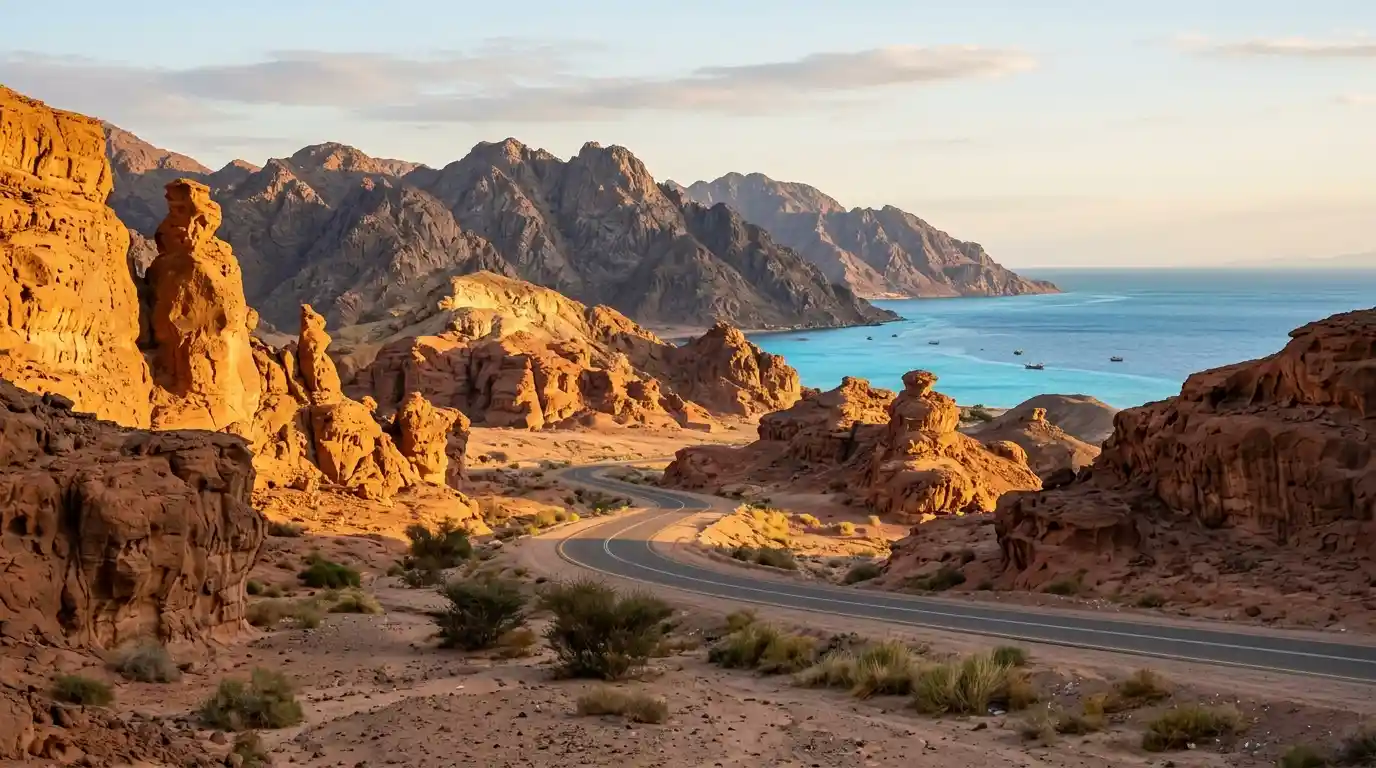
The Bajdah Rewilding Site is one of the clearest places around which to build a NEOM itinerary because NEOM currently states that it is open to the public and managed by local rangers. Visitors can see a conservation landscape where reintroduced animals include gazelles and ostriches, while the surrounding Hisma desert provides red dunes, sandstone cliffs and unusual rock formations.
This combines several NEOM themes in one place: nature restoration, wildlife, desert scenery and local ranger involvement. It is therefore considerably more useful to an actual traveler than simply driving toward a major construction site.
Give Bajdah meaningful time. A rewilding area should not be approached as a rapid roadside photo stop. Follow ranger instructions, remain where visitors are permitted and keep noise and disturbance low around wildlife.
The surrounding desert can also be visually spectacular, but do not assume every track is available for recreational off-roading. NEOM’s conservation program covers enormous areas and includes active regeneration and species-reintroduction work.
Travelers who want nature to form the core of their route can continue to best nature spots in NEOM and outdoor activities in NEOM.
Use Bajdah as a Route Block, Not an Add-On
A good NEOM itinerary treats Bajdah as a major geographic block rather than adding it casually between unrelated destinations.
Road conditions, ranger arrangements and the amount of time you want for wildlife observation all influence how long you should allow. Bring more drinking water than you think you will need, protect yourself from sun exposure and make sure your vehicle and phone are prepared for remote travel.
Photography can easily extend the visit because sandstone and desert light change dramatically through the day. If photography is important, the workbook-mapped NEOM photography spots guide can help refine locations without turning this itinerary into a photography article.
The key principle is simple: once you commit to the desert branch, experience it properly rather than rushing away simply to add another NEOM name to your checklist.
Decide Whether the Mountains Belong in Your Route
Trojena sits within NEOM’s high mountain environment in the Jabal Al Lawz range. Current official information describes the region as reaching approximately 2,600 meters above sea level and notes that winter temperatures can fall below freezing at elevation.
That makes the mountain branch radically different from the coast or Bajdah.
Do not assume Trojena is already operating like a conventional mountain resort where every promoted facility can be booked independently. NEOM presents it as a developing year-round mountain region, so the practical question is not whether Trojena appears on a destination map but what visitor experience is actually accessible during your trip.
If you have confirmed access, treat the mountains as their own NEOM itinerary block. Mountain roads, elevation, weather and longer travel times all deserve space.
The mountain branch is particularly attractive for landscapes, cooler conditions and dramatic topography. It should not, however, be squeezed between a remote desert experience and an airport departure simply because the locations appear within the same regional brand.
Weather Can Change the Entire Route
NEOM’s size and elevation range mean that one forecast cannot adequately represent the entire destination. Trojena’s mountain environment can be dramatically cooler than lower coastal and desert areas, while the Gulf of Aqaba and Red Sea introduce their own wind and marine conditions.
This should affect both packing and itinerary order.
Check conditions for the specific area you are visiting, not simply “NEOM.” A mountain excursion may require warmer clothing while a desert or coastal block requires strong sun protection on the same broader journey.
The decision about which season gives you the best balance belongs in best time to visit NEOM. Travelers whose dates are already fixed can use NEOM weather by month for climate-reference detail.
Add Magna Only With a Confirmed Access Plan
Magna stretches along approximately 120 kilometers of Gulf of Aqaba coastline, where mountains, valleys and sea create one of NEOM’s most visually dramatic environments. NEOM currently describes the majority of the area as conserved for nature and emphasizes its combination of desert valleys and coastal landscapes.
That sounds ideal for travel, but a planning distinction matters: many of the hospitality concepts associated with Magna remain development projects rather than ordinary walk-in attractions.
Do not create a route that simply says “drive to Magna” without knowing your actual destination. Confirm a currently accessible resort, experience, road, tour or public point first.
Once that access is established, the Gulf of Aqaba can provide an excellent contrast with Bajdah or the mountains. The experience shifts from sandstone and desert to steep coastal topography and deep blue water.
Without confirmed access, keep Magna as an optional branch rather than the foundation of the entire NEOM itinerary.
Treat THE LINE Differently From a Tourist District
THE LINE may be the best-known component of NEOM internationally, but current official information describes it as a multi-phased development advancing through a phased, demand-led approach.
That language should guide your expectations.
Do not plan to arrive, park and walk through a finished urban district. Construction and development zones may involve controlled access, security restrictions and safety requirements.
If an official visitor center, organized experience or other permitted public opportunity is available for your dates, it can be added to the route. Otherwise, do not make an independent construction-site visit the centerpiece of your trip.
A NEOM itinerary should distinguish between learning about the project and physically entering the project area.
Keep Oxagon Outside an Ordinary Leisure Route
Oxagon is NEOM’s industrial and logistics hub, and Port of NEOM operates as working infrastructure supporting regional trade. NEOM describes the port as operational around the clock while Oxagon continues to develop as a major industrial ecosystem.
For ordinary travelers, this makes Oxagon very different from Bajdah or a coastal leisure destination.
Operational ports, factories and industrial infrastructure should not be treated as informal sightseeing locations. Access restrictions and photography controls may apply, and heavy industrial traffic creates practical safety considerations.
Unless an official public experience specifically includes Oxagon, leave it outside a normal leisure NEOM itinerary.
Understanding its role can still help you understand NEOM as a whole; visiting the operational infrastructure is a different question.
Consider a Red Sea Marine Branch
The broader NEOM region contains extraordinary marine environments. Official NEOM information describes surrounding island waters as supporting more than 300 coral species and over a thousand fish and marine-mammal species.
If a legitimate operator or accessible coastal destination is available, a marine experience can provide one of the strongest contrasts within a NEOM itinerary.
The planning requirement is confirmation. Do not assume that every island shown in project imagery has public boat access or that every attractive piece of coastline functions as a public beach.
When a confirmed experience exists, marine conditions matter. Wind, waves and visibility should determine whether boating or snorkeling goes ahead.
For those specific sub-intents, use boat trips in NEOM and snorkeling in NEOM. Travelers who prefer shore-based recreation can compare current options through best beaches in NEOM.
Arrive Through NEOM Bay Airport When Air Travel Makes Sense
NEOM Bay Airport, with the IATA code NUM, is the main operational airport serving the region. Its current official information describes domestic and international connectivity and advises passengers to use the operating airlines for current routes and booking information.
For itinerary planning, the more important point is what happens after you land.
NEOM Bay Airport currently lists several rental-car providers and ground-transport services. Its published passenger guidance says public transport is not available to ordinary visitors; taxis and rental cars are the practical options, while NEOM community buses serve community residents rather than functioning as a general visitor network.
This makes prearranged ground transport important.
Do not land expecting a metropolitan rail or public-bus network to carry you around the wider region. Arrange a rental car or transfer appropriate to your actual destination, and confirm that the vehicle and driver are suitable for the roads you intend to use.
Do Not Underestimate Driving Distances
NEOM’s 26,500-square-kilometer footprint should immediately change how you think about transport.
A NEOM itinerary is closer to regional road-trip planning than conventional city sightseeing. Attractions can be separated by substantial distances, and individual areas may have access controls that force you to use a particular road rather than the most direct-looking route on a map.
Keep fuel levels healthy, carry water and maintain a charged phone. Download navigation information before entering areas where connectivity may be less predictable.
Avoid improvised off-road shortcuts. A road that appears to head toward your destination may cross protected, controlled or operational land.
When the route becomes ambitious, removing one distant branch often improves the trip more than trying to drive faster.
Where to Base Yourself
Accommodation in NEOM requires current verification because hospitality projects are developing at different speeds.
Do not assume that every announced resort or internationally branded hotel you have seen in project coverage is open and bookable for ordinary travelers. Confirm operating accommodation through recognized booking or hotel channels for your actual dates.
Your base should follow the experiences you can access.
If Bajdah is your main confirmed experience, accommodation that minimizes the associated road travel may make more sense than choosing a property because it is associated with another NEOM development. If a coastal stay is confirmed, remaining near that coastal experience may reduce unnecessary cross-region travel.
Location is more important than collecting hotel brands in a region this large.
A Nature-First NEOM Itinerary
For many current leisure travelers, a nature-first approach is the most grounded way to experience NEOM.
Use Bajdah as the principal anchor. Give the Hisma environment time for wildlife observation, landscapes and responsible exploration. Add a second branch only when it is genuinely accessible and provides a different environment, such as confirmed mountain or coastal access.
This route aligns with NEOM’s own current emphasis on conservation and visitor experiences within the nature reserve. The organization reports large-scale rewilding, regreening and marine restoration alongside visitor programs managed by local rangers.
A nature-first itinerary also avoids the common mistake of treating construction progress as tourism.
For travelers interested in less obvious natural environments, hidden gems in NEOM can provide additional ideas, provided every location is rechecked for current access.
A Coast-and-Mountains Route
A coast-and-mountains NEOM itinerary can offer the greatest environmental contrast, but only when both components are confirmed.
The Gulf of Aqaba coast combines water, steep mountains and desert valleys, while Trojena reaches high elevations where the climate and landscape change dramatically.
This can produce an exceptional journey for landscape-oriented travelers, but it also creates more road time and more complicated packing.
Do not plan the mountain section as though it were simply a cooler neighborhood above the coast. Treat elevation, weather and access separately.
Similarly, do not use a vague coastal development name as a destination. Identify the actual accessible accommodation, activity or meeting point before setting out.
Families Need a More Conservative Route
NEOM can be interesting for families, particularly when children enjoy wildlife, geology and outdoor environments, but the region’s scale makes overplanning especially tiring.
Bajdah’s rewilding experience is potentially valuable because children can connect the landscape with visible conservation work. However, long drives, strong sun, remote surroundings and limited spontaneous facilities require more preparation than a conventional family resort.
Keep travel blocks manageable, carry sufficient food and water and know where reliable bathrooms and rest stops are located.
Do not build a family itinerary around several uncertain-access destinations. Confirm everything important before leaving your accommodation.
The dedicated NEOM with kids guide covers family tradeoffs more fully.
Accessibility Must Be Checked Stop by Stop
Modern infrastructure does not mean every NEOM experience is currently accessible to every traveler.
NEOM Bay Airport provides passenger facilities and participates in accessibility initiatives for people with non-visible disabilities, but natural destinations introduce different barriers. Desert sand, uneven rock, mountain terrain and smaller marine craft can all present mobility challenges.
Travelers who use wheelchairs or require step-free vehicles should confirm the complete chain: airport assistance, rental or transfer vehicle, accommodation, attraction access and bathrooms.
Do not rely on a general claim that a development is modern or future-focused. Ask about the specific experience you intend to book.
Plan Photography Without Crossing Security Boundaries
NEOM’s landscapes are naturally photogenic, particularly Bajdah, the mountains and Gulf of Aqaba environments. Sunrise and late afternoon can produce excellent light on sandstone and granite, while clear desert skies may also appeal to night photographers.
But photography requires greater awareness near infrastructure.
Avoid photographing restricted construction, security installations, airports, ports or industrial areas when signage or authorities prohibit it. Do not launch a drone without confirming all applicable aviation, security and protected-area rules.
Natural photography is often both safer and more rewarding than trying to capture active worksites.
For travelers who want to organize late-day photography, sunset spots in NEOM should be checked against the workbook URL before publication.
Keep a Backup Plan
Access is evolving, and that makes a backup plan unusually important for a NEOM itinerary.
Before departure, identify the primary experience you want, a secondary alternative and an indoor or low-complexity fallback. If an access condition, weather issue or operational change affects one branch, you can adapt without losing the entire trip.
This is particularly important for travelers flying specifically to NUM rather than combining NEOM with a wider northwest Saudi journey.
A short trip has even less margin for access changes. Travelers planning a compact break can use weekend in NEOM for the duration-specific structure instead of compressing an open-ended regional route into too little time.
Responsible Travel Should Shape the Route
NEOM’s current nature program includes large-scale regreening, wildlife reintroduction and marine conservation. More than 1,300 animals from native species have been reintroduced, while tens of thousands of hectares are under active regeneration.
That makes responsible behavior central rather than optional.
Stay on permitted routes. Do not chase wildlife with vehicles. Never remove rocks, fossils, plants or archaeological material. Avoid damaging cryptobiotic or fragile desert surfaces through unnecessary off-road driving.
Around reefs and islands, do not touch coral, collect shells from protected environments or approach nesting wildlife too closely.
The point of reaching an unusual landscape is not to leave evidence that you were there.
Practical NEOM Itinerary Checklist
Before finalizing your NEOM itinerary, confirm the following:
- The exact places you intend to visit are currently open to ordinary visitors.
- Any required reservation, ranger, operator or access permission is arranged.
- Your accommodation is actually operating and bookable for your dates.
- Your airport-to-accommodation transfer is confirmed.
- You have a rental car or private transport where needed.
- Your route does not depend on restricted construction or industrial areas.
- Mountain and coastal conditions have been checked separately.
- You have sufficient water and supplies for remote road travel.
- Marine activities have enough flexibility for weather changes.
- You have a backup activity if access changes.
This preparation may look more extensive than planning an ordinary city break, but it reflects the destination accurately.
How to Make the Route Feel Less Rushed
The best NEOM itinerary is not the one that contains THE LINE, Trojena, Magna, Bajdah, Oxagon and several islands simply because those names are associated with the same project.
Instead, choose a theme.
A nature-focused trip might center on Bajdah and another confirmed landscape. A mountain-focused route can prioritize high-elevation scenery if access is available. A marine trip can concentrate on a legitimate coastal base and operator. A development-focused visit should use whatever official visitor experiences are actually open rather than trying to observe construction independently.
That approach gives each part of NEOM enough time to feel meaningful.
It also protects you from one of the biggest planning errors: spending most of the journey in a vehicle simply because the regional map made everything look closer than it is.
Final Thoughts
A successful NEOM itinerary requires a different mindset from planning a mature tourism city. NEOM is enormous, geographically diverse and still developing, so current access matters more than a theoretical list of attractions.
Start with what is clearly available. The Bajdah Rewilding Site is currently described by NEOM as open to the public, making it one of the strongest grounded anchors for a nature-focused trip. NEOM Bay Airport gives the region a working air gateway, but ordinary visitors should arrange taxis, rental cars or private transfers because general public transport is not currently the main way to move around the region.
Add Trojena, Magna, coastal experiences or development-focused stops only when current official information confirms that your intended experience is accessible. Treat THE LINE as a phased development rather than a finished urban sightseeing district, and keep working industrial infrastructure such as Oxagon outside an ordinary leisure route unless an official visitor program says otherwise.
Most importantly, let NEOM’s landscapes determine the journey. The Hisma desert, conservation areas, mountains and Gulf of Aqaba are substantial experiences in their own right. A carefully planned route with two excellent, genuinely accessible environments will usually be more rewarding than an ambitious checklist built around places that are still taking shape.
Frequently Asked Questions
What is the best way to plan a NEOM itinerary?
Start by confirming which places are genuinely open to visitors for your dates. Build the route around one primary geographic area, such as Bajdah, then add a compatible mountain or coastal experience only if access is confirmed.
Is Bajdah open to tourists?
NEOM currently describes the Bajdah Rewilding Site as open to the public and managed by local rangers. It is one of the clearest current visitor experiences within the NEOM Nature Reserve.
Can I include THE LINE in my itinerary?
Only through a currently permitted visitor opportunity. NEOM describes THE LINE as a multi-phased development, so it should not be treated as a finished public sightseeing district.
Can I visit Trojena?
Trojena is an active mountain-region development. Verify current public access and specific bookable experiences before adding it to your route. Its high elevation also means weather can differ sharply from the coast.
Is Magna open for sightseeing?
Do not assume the entire Magna region functions as an open tourist district. NEOM describes a large Gulf of Aqaba coastal region with developing destinations, so identify and verify a specific accessible location or experience first.
Which airport should I use for NEOM?
NEOM Bay Airport uses the IATA code NUM and serves as the main operational air gateway into the region. Check current routes directly with operating airlines.
Is there public transport for tourists in NEOM?
Current NEOM Bay Airport passenger guidance says ordinary public transport is not available; taxis and rental cars are the primary visitor options, while community buses serve NEOM community residents.
Do I need a rental car?
A rental car can be highly useful because NEOM covers a vast area. A private driver or arranged transfer may be preferable if you are uncomfortable with remote road travel or if access to your destination requires local coordination.
Can families visit NEOM?
Yes, but the trip needs more preparation than a conventional family resort. Confirm facilities, limit long driving blocks and carry adequate water and supplies, particularly when visiting desert or nature areas.
Can I visit NEOM beaches?
Potentially, but access varies by location. Verify that the specific beach or coastal experience is publicly accessible rather than assuming all NEOM coastline is open recreation space.
Should I try to see all major NEOM regions on one trip?
Usually not. The region is extremely large, and several developments have differing access conditions. Choosing fewer confirmed experiences creates a more practical and enjoyable journey.
What is the most important thing to know before visiting NEOM?
NEOM is a developing region, not a completed futuristic city. Verify the current status of every major stop before travel and build the itinerary around places that are genuinely accessible.